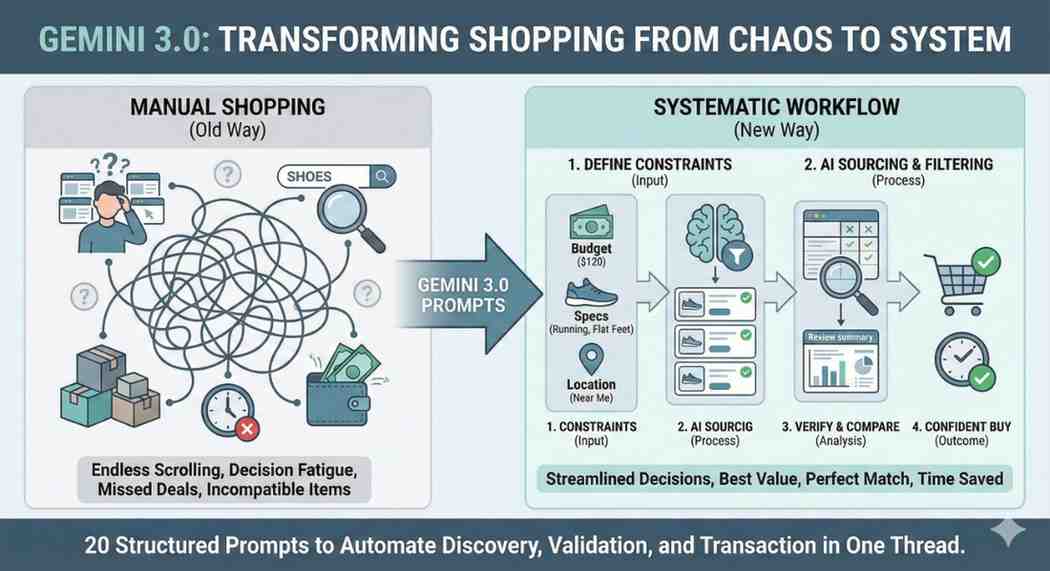
In my holiday season shopping spree, I noticed that modern shopping is inefficient. You waste hours scrolling through infinite lists and cross-referencing tabs. This manual process leads to decision fatigue and suboptimal purchases.
Not many know that, Gemini 3.0 eliminates this friction by treating shopping as a logic problem rather than a browsing activity. You define the constraints, and the AI handles the retrieval.

The following 20 prompts turn your requirements into immediate, actionable product options.
1. The Gift Sourcing Engine
Most people guess when they buy gifts. They browse generic categories and hope for the best. A systematic approach uses specific persona constraints to filter the noise. This prompt forces the AI to analyze the recipient’s interests against available inventory.
Prompt
“Act as a professional personal shopper. I need gift suggestions for a [Insert Persona, e.g., tech-loving dad] who enjoys [Insert Hobbies, e.g., vintage audio, woodworking]. The budget is under $[Insert Amount]. Prioritize items with high durability and user ratings above 4.5 stars. Provide 5 distinct options with direct purchase links and a one-sentence justification for each. Ask for more detail if required.”
2. Event Logistics Planner
Amateurs pack for trips by throwing random items into a bag. Professionals build lists based on the specific environment and duration. This workflow converts a trip description into a procured packing list.
Prompt
“Create a comprehensive packing list for a [Insert Duration, e.g., 3-day] [Insert Activity, e.g., camping trip] in [Insert Location/Weather]. Categorize the list by ‘Essentials’, ‘Food’, and ‘Gear’. For every item I likely do not own, provide a specific product recommendation available for purchase. Show me the total estimated cost for the gear. Ask for more detail if required.”
3. Visual Part Replacement
Text queries fail when you do not know the technical name of a broken part. Visual search bridges this gap. You use the camera to identify the object and the AI to find the supply chain.
Prompt
“[Upload image of broken part/item] Analyze this image to identify the specific product or component. Search for compatible replacements available for purchase online. Prioritize original equipment manufacturer (OEM) parts if available. Provide direct links to the three best buying options sorted by price. Ask for more detail if required.”
4. Constraint-Based Footwear Search
Generic searches for “shoes” yield useless results. You must layer functional requirements to get value. This prompt filters inventory by biomechanics and price, which saves you from reading technical specs manually.
Prompt
“Find [Insert Category, e.g., running shoes] specifically designed for [Insert Condition, e.g., flat feet, overpronation]. Filter for options under $[Insert Price]. Exclude brands with known durability issues. Present the top 3 choices with a comparison of their arch support features. Ask for more detail if required.”
5. Iterative Attribute Refinement
The first search result is rarely perfect. You treat the interaction as a conversation to refine the output. This workflow takes an existing set of results and filters them by aesthetic or budgetary constraints without restarting the search.
Prompt
“Review the product suggestions from the previous response. Filter this list to show only the options available in [Insert Color/Material]. If this eliminates all options, find the closest alternatives that match the visual style. Display the new list with current prices. Ask for more detail if required.”
6. Local Inventory Check
Shipping times delay projects. You often need items immediately. This workflow triggers the local search capabilities to find stock near your physical location.
Prompt
“Identify the [Insert Product] mentioned in our chat. Search for this specific item in local inventory near [Insert City/Zip Code]. Provide a list of stores that have it in stock today along with their current operating hours. Ask for more detail if required.”
7. The “Buy for Me” Validator
Automated purchasing requires data integrity. You must verify model numbers and shipping dates before committing. This prompt acts as a final safety check to ensure the AI has the correct specifications.
Prompt
“I intend to buy the [Insert Product Name] from the list. Verify the specific model number, current price, and estimated delivery date. Confirm that this model includes [Insert Critical Feature]. Summarize these details so I can approve the purchase. Ask for more detail if required.”
8. Price Floor Discovery
Sticker prices are often inflated. You can save money by asking the AI to find the lowest market price for a specific SKU. This prompt leverages data across multiple vendors.
Prompt
“Locate the best current price for [Insert Product Name/Model]. Compare major retailers and flag any active coupon codes or price drops. Calculate the total cost including shipping to [Insert Location]. Ask for more detail if required.”
9. Bulk Meal Prep Sourcing
Grocery shopping consumes hours of mental energy. You can automate the meal planning and the list creation simultaneously. This prompt turns dietary goals into a shopping cart.
Prompt
“Plan a meal schedule for [Insert Days] days based on a [Insert Diet, e.g., Keto, Vegan] diet. Generate a complete grocery shopping list based on these recipes. Group items by store aisle. highlight any ingredients that can be bought in bulk to save money. Ask for more detail if required.”
10. Tech Ecosystem Compatibility
Buying tech requires checking compatibility with your existing gear. A manual check is prone to error. This prompt forces the AI to cross-reference specifications.
Prompt
“I am considering buying [Insert New Product]. Check its compatibility with my existing setup: [Insert Current Devices, e.g., iPhone 14, MacBook Air M2]. List any necessary adapters or cables I need to purchase to make them work together seamlessly. Ask for more detail if required.”
11. The Budget Maximizer
Strict budgets often lead to low-quality purchases. You can use AI to find the best value within a cap. This prompt prioritizes quality-to-price ratio.
Prompt
“I have a strict budget of $[Insert Amount] for a [Insert Product Category]. Find the highest-rated options that fit this budget. Do not show items that exceed the limit. Rank them by user review sentiment regarding longevity. Ask for more detail if required.”
12. Review Sentiment Analysis
Reading hundreds of reviews is a waste of time. You need the aggregate data. This workflow summarizes the pros and cons to inform your decision.
Prompt
“Analyze the customer reviews for [Insert Product]. Summarize the top three recurring complaints and the top three praised features. Tell me if there is a consensus on long-term reliability. Ask for more detail if required.”
13. Sustainable Alternative Search
You often want to buy responsibly but lack the research time. This prompt swaps standard products for eco-friendly equivalents.
Prompt
“I need a [Insert Product, e.g., laundry detergent]. Suggest 3 sustainable or plastic-free alternatives to leading brands. Compare their price per unit against the standard options. Ask for more detail if required.”
14. Occasion Outfit Coordinator
Matching clothes for an event is difficult. This workflow acts as a stylist to build a cohesive look from available inventory.
Prompt
“Create a complete outfit for a [Insert Occasion, e.g., summer outdoor wedding]. The style should be [Insert Style, e.g., smart casual]. Include shoes and accessories. Ensure all items are available for immediate purchase and color-coordinated. Ask for more detail if required.”
15. Post-Purchase Support Finder
Buying the item is only the first step. You often lose manuals or need support. This prompt locates the documentation you need.
Prompt
“Find the official digital user manual for [Insert Product Model]. Locate the customer support contact page and warranty registration link. Provide these as direct links. Ask for more detail if required.”
16. The “Wait or Buy” Predictor
Amateurs purchase items the moment they find them. Strategic buyers analyze market cycles to avoid overpaying. This workflow uses historical data and seasonal trends to determine if a price drop is imminent. You use this to time your capital expenditure rather than reacting to impulse.
Prompt
“I am planning to buy [Insert Product, e.g., 65-inch OLED TV]. Analyze the price history trends for this category over the last 12 months. Based on upcoming sales events (like Black Friday, Prime Day, or End of Season), predict whether the price is likely to drop in the next 30 days. Recommend whether I should ‘Buy Now’ or ‘Wait’. Ask for more detail if required.”
17. The Fine Print Auditor
Most shoppers ignore return policies until it is too late. This negligence results in sunk costs when a product fails to meet expectations. This prompt forces the AI to extract and summarize the critical risk factors—restocking fees, return windows, and warranty voids—before you spend a dollar.
Prompt
“I am looking at purchasing [Insert Product] from [Insert Retailer]. Extract and summarize the return policy and warranty terms. Specifically, identify if there are restocking fees, who pays for return shipping, and the exact duration of the return window. Rate the ‘Risk Level’ of this purchase from Low to High based on these terms. Ask for more detail if required.”
18. The DIY Bundle Architect
Pre-packaged kits are often overpriced and filled with low-quality fillers. You get better value by sourcing high-quality individual components. This workflow breaks down a generic kit into a custom list of superior parts, often for a similar total price.
Prompt
“I want to build a custom [Insert Kit Type, e.g., Home Emergency Kit / Podcast Starter Setup]. Instead of a pre-made bundle, list the essential individual components I need to buy to create a high-quality version myself. For each component, suggest a specific, highly-rated product available for purchase. Ensure the total cost remains under $[Insert Budget]. Ask for more detail if required.”
19. Total Cost of Ownership Calculator
The sticker price is irrelevant if the maintenance costs are high. Amateurs buy cheap printers; professionals calculate the cost of ink per page. Use this workflow to reveal the hidden long-term costs of “cheap” hardware, including energy consumption, subscriptions, and consumables.
Prompt
“Compare the ‘Total Cost of Ownership’ over 3 years for [Insert Product A] versus [Insert Product B]. Include the initial purchase price, estimated energy usage, and the cost of necessary consumables (filters, batteries, ink, or subscriptions). Tell me which option is mathematically cheaper in the long run. Ask for more detail if required.”
20. The Spec-Sheet Battle Matrix
Marketing fluff obscures the technical reality of a product. You cannot rely on product descriptions alone. This prompt strips away the branding and forces a direct, line-by-line comparison of technical specifications between two competitors to reveal the superior engineering.
Prompt
“Create a comparison table between [Insert Product A] and [Insert Product B]. The rows should be technical specifications only (e.g., battery size in mAh, material composition, processor speed, weight). Exclude all marketing terms. Add a final row declaring the ‘Technical Winner’ based purely on specs. Ask for more detail if required.”
Scale Your Shopping Engine
Systematic shopping beats reactive buying. You save time and money when you build workflows around your consumption. These prompts allow you to delegate the research, filtering, and logistics to Gemini. Stop searching for products manually. Start commanding your AI to procure them.