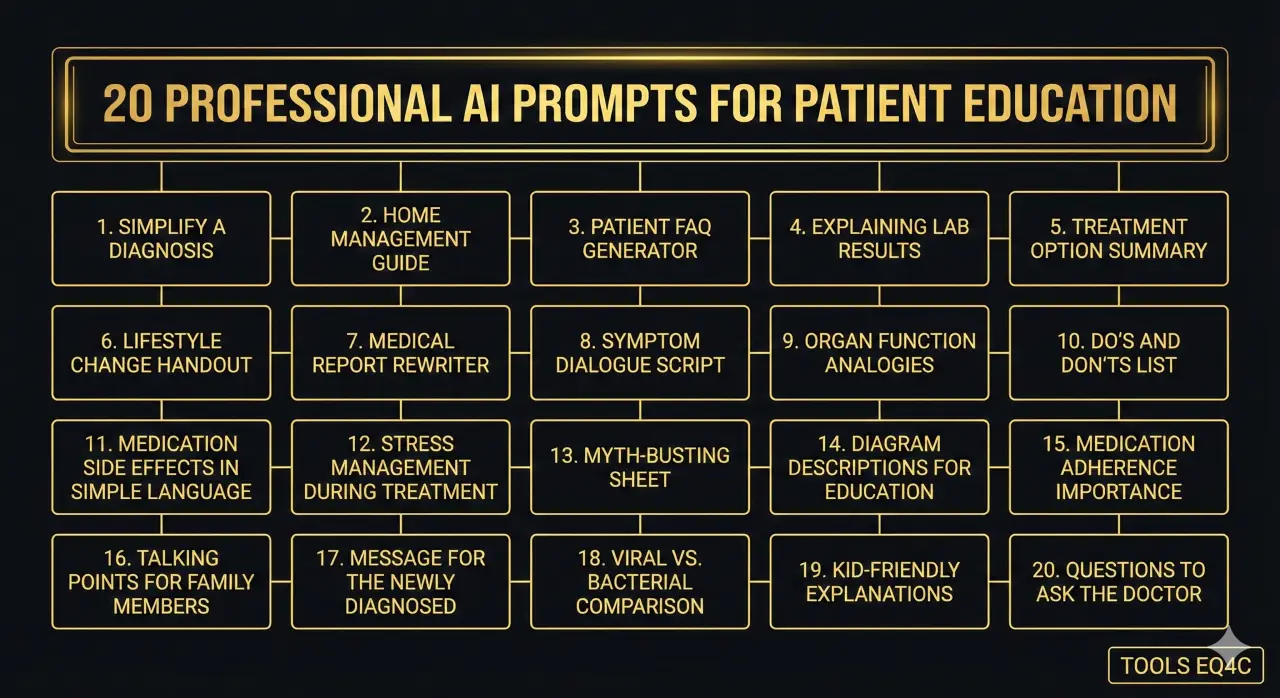
Clear communication is the heart of good healthcare. Doctors and nurses often use hard words. Patients can feel lost or scared. This guide helps you fix that problem.
We have built 20 prompts to help you talk to patients. These tools turn complex data into simple steps. They help patients take care of themselves at home. You will save time and improve lives.

Better Tools for Patient Care
Patient education is more than just giving out facts. it is about making sure people feel safe. It involves explaining tests and correcting common myths. These prompts cover every part of the patient journey.
You can use these to write handouts or scripts. They work for kids and adults alike. Use them to make your clinic a more welcoming place. Your patients will thank you for being so clear.
How to Use These Prompts
- Find the use case that fits your current need.
- Copy the entire prompt inside the blockquote.
- Paste the prompt into your AI assistant.
- Fill in the bracketed information with your data.
- Review the result for medical accuracy.
- Print or send the text to your patient.
1. Simplify a Diagnosis
This prompt turns a hard medical condition into simple words. It is for patients with no medical background.
Act as a health literacy expert. Your objective is to explain a medical condition to a patient with a fifth-grade reading level. Context: The patient is newly diagnosed and feels overwhelmed by technical terms. Instructions:
- Use the ‘Teach-Back’ method style.
- Avoid all medical jargon.
- Use a comforting and direct tone.
- Focus on what the condition feels like and why it happens.
Constraints: Use sentences shorter than 15 words. Avoid words with more than three syllables. Reasoning: Patients retain more information when it is delivered in simple, bite-sized pieces. Output Format: A short, three-paragraph explanation. User Input: [Insert Condition Here]
Expected Outcome A short and easy explanation. The patient will understand their health without feeling scared.
User Input Examples
- Hypertension
- Sleep Apnea
- Glaucoma
2. Home Management Guide
Create a clear list of steps for patients to follow at home. This helps prevent hospital returns.
You are a home health nurse. Your goal is to provide a step-by-step guide for a patient to manage their condition safely at home. Context: The patient has just been discharged and needs a clear routine. Instructions:
- List daily tasks in order of importance.
- Define clear ‘Red Flags’ that mean the patient should call the doctor.
- Include tips for diet and activity.
Constraints: Use a checklist format with boxes. Highlight safety warnings in bold. Reasoning: Checklists reduce errors and help patients feel empowered in their recovery. Output Format: A structured daily checklist. User Input: [Insert Condition Here]
Expected Outcome A practical checklist for daily use. It makes home care feel manageable and safe.
User Input Examples
- Post-Hip Surgery
- Congestive Heart Failure
- Wound Care
3. Patient FAQ Generator
This prompt creates a list of common questions and answers. It saves you time during consultations.
You are a patient advocate. Your objective is to generate a ‘Frequently Asked Questions’ sheet for a specific diagnosis. Context: Patients often forget to ask important questions during a short office visit. Instructions:
- Brainstorm the top five questions a patient usually has.
- Provide clear, empathetic answers.
- Address concerns about cost, time, and pain.
Constraints: Keep each answer under 50 words. Use a friendly, conversational tone. Reasoning: Anticipating questions reduces patient anxiety and builds trust. Output Format: Q&A list. User Input: [Insert Condition Here]
Expected Outcome A helpful sheet that answers common worries. It prepares the patient for their treatment journey.
User Input Examples
- Cataract Surgery
- Starting Physical Therapy
- MRI Scans
4. Explaining Lab Results
Use this prompt to turn a lab report into a clear conversation script.
You are a primary care physician. Your goal is to write a script for explaining lab results to a patient over the phone. Context: The patient has seen their results online and is confused by the numbers. Instructions:
- Explain what the test measures.
- Explain what ‘out of range’ means for this specific patient.
- State the plan for moving forward.
Constraints: Do not use raw data without context. Use reassuring language. Reasoning: Patients need to know the ‘so what’ behind the numbers to stay compliant. Output Format: A conversational script. User Input: [Insert Lab Results or Marker Here]
Expected Outcome A professional script that makes data easy to hear. It prevents patient panic over minor lab variations.
User Input Examples
- Low Iron
- High Blood Sugar
- Abnormal Liver Enzymes
5. Treatment Option Summary
This prompt compares different treatments in plain English. It helps with shared decision-making.
You are a medical consultant. Your objective is to summarize treatment options for a patient so they can make a choice. Context: The patient has multiple paths forward and feels stuck. Instructions:
- List Option A, Option B, and Option C.
- For each, list one big ‘Pro’ and one big ‘Con’.
- Explain the goal of each treatment.
Constraints: Use a neutral tone. Do not tell the patient which one to pick. Reasoning: Presenting options clearly supports the patient’s right to choose their care. Output Format: A simple comparison table. User Input: [Insert Condition Here]
Expected Outcome A clear table showing pros and cons. The patient will feel ready to discuss their choice with you.
User Input Examples
- Herniated Disc
- Early-stage Prostate Cancer
- Severe Acne
6. Lifestyle Change Handout
Help patients change their habits with this supportive handout prompt.
You are a health coach. Your goal is to create a handout for lifestyle changes related to a specific diagnosis. Context: The patient needs to change their diet or exercise but does not know where to start. Instructions:
- Suggest three ‘Small Wins’ the patient can do this week.
- Explain why these changes help their specific condition.
- Provide a list of ‘Swap This for That’ examples.
Constraints: Avoid being judgmental. Use motivating language. Reasoning: Incremental changes are more sustainable than total life overhauls. Output Format: An encouraging one-page flyer. User Input: [Insert Condition Here]
Expected Outcome A positive flyer that makes change feel possible. It breaks big goals into small steps.
User Input Examples
- High Cholesterol
- Pre-Diabetes
- Gout
7. Medical Report Rewriter
Turn a technical report into a letter a patient can actually read.
You are a medical translator. Your objective is to rewrite a technical medical report into a letter for the patient. Context: The patient has a copy of their specialist report but cannot understand the jargon. Instructions:
- Translate every medical term into a common word.
- Summarize the ‘Main Finding’.
- Highlight the ‘Next Step’ recommended by the doctor.
Constraints: Keep the tone professional but very simple. Reasoning: Patients who understand their reports are more likely to follow up with specialists. Output Format: A formal letter to the patient. User Input: [Insert Medical Report Text Here]
Expected Outcome A letter that explains a report clearly. It removes the mystery of medical shorthand.
User Input Examples
- Radiology report for a knee scan
- Pathology report after a biopsy
- Cardiology consultation notes
8. Symptom Dialogue Script
Create a script to help patients describe their symptoms to you more effectively.
You are a clinical communication specialist. Your goal is to write a dialogue between a doctor and a patient about a specific symptom. Context: Patients often struggle to describe pain or symptoms accurately. Instructions:
- Show the patient how to use the ‘OPQRST’ (Onset, Provocation, Quality, Radiation, Severity, Time) method in conversation.
- Provide examples of descriptive words for pain.
- Include tips for the patient on how to be concise.
Constraints: Use a role-play format. Reasoning: Teaching patients how to describe symptoms leads to faster and more accurate diagnoses. Output Format: A two-person script. User Input: [Insert Symptom Here]
Expected Outcome A script that teaches patients how to speak ‘doctor’. This makes your intake process much faster.
User Input Examples
- Chest Pain
- Chronic Migraines
- Abdominal Discomfort
9. Organ Function Analogies
Use stories to explain how the body works.
You are a teacher. Your objective is to provide three analogies to explain how an organ or system works. Context: The patient does not understand why their organ is failing or how it functions. Instructions:
- Use everyday objects (like plumbing, electricity, or cars).
- Explain the organ’s job using that object.
- Connect the analogy to the patient’s current health issue.
Constraints: Keep analogies relatable to a general audience. Reasoning: Analogies create ‘mental hooks’ that help patients remember complex biological functions. Output Format: Three distinct analogy sections. User Input: [Insert Organ/System and Condition Here]
Expected Outcome Three clear stories that explain biology. These are perfect for patient handouts or quick office talks.
User Input Examples
- Pancreas (Diabetes)
- Lungs (Asthma)
- Liver (Cirrhosis)
10. Do’s and Don’ts List
A quick reference guide for patients to keep on their fridge.
You are a safety officer in a hospital. Your goal is to create a ‘Do’s and Don’ts’ list for a specific patient condition. Context: The patient needs a quick reference for safe daily living. Instructions:
- Create a two-column list.
- Include things to avoid (medications, foods, activities).
- Include things to prioritize.
Constraints: Use very short, punchy sentences. Reasoning: Brief lists are easier to scan during high-stress moments. Output Format: A T-chart or two-column list. User Input: [Insert Condition Here]
Expected Outcome A simple guide for daily life. It helps patients avoid common mistakes that cause flare-ups.
User Input Examples
- Taking Blood Thinners
- After a Concussion
- Living with a Pacemaker
11. Medication Side Effects in Simple Language
Explain what to expect when starting a new drug.
You are a pharmacist. Your objective is to explain medication side effects in simple language. Context: The patient is afraid to start a new drug because of the long warning label. Instructions:
- Group side effects into ‘Common’ and ‘Serious’.
- Explain how to manage common ones at home.
- Tell the patient exactly when to stop the medicine and call you.
Constraints: Use a calm, reassuring tone. Do not minimize serious risks. Reasoning: Understanding side effects reduces ‘nocebo’ effects and increases adherence. Output Format: A ‘What to Expect’ info sheet. User Input: [Insert Medication Name Here]
Expected Outcome A balanced view of the medication. The patient will feel informed but not terrified.
User Input Examples
- Prednisone
- Statins
- Chemotherapy drugs
12. Stress Management During Treatment
Support the patient’s mental health during physical recovery.
You are a social worker. Your goal is to create a short info sheet about managing stress during medical treatment. Context: The patient is overwhelmed by their diagnosis and the treatment schedule. Instructions:
- List three 5-minute stress relief techniques.
- Explain why stress can slow down physical healing.
- Provide resources for mental health support.
Constraints: Use soft, supportive language. Reasoning: Mental health is a key part of physical recovery. Output Format: A comforting one-page guide. User Input: [Insert Treatment/Condition Here]
Expected Outcome A calming guide for the patient. It shows that you care about their mind as well as their body.
User Input Examples
- Dialysis
- Cancer Treatment
- Chronic Pain Management
13. Myth-Busting Sheet
Correct common misinformation that patients find online.
You are a medical researcher. Your objective is to summarize and correct common myths about a specific condition. Context: The patient has been reading unreliable sources online. Instructions:
- State the myth clearly.
- Provide the medical fact.
- Explain why the myth started if possible.
Constraints: Be respectful. Do not make the patient feel silly for believing the myth. Reasoning: Correcting misinformation early prevents dangerous self-treatment. Output Format: A ‘Myth vs. Fact’ table. User Input: [Insert Condition Here]
Expected Outcome A clear table that clears up confusion. It helps the patient focus on real medicine.
User Input Examples
- Vaccines
- Celiac Disease
- Back Pain
14. Diagram Descriptions for Education
Since AI cannot draw yet, use this to describe what a diagram should look like for a patient.
You are a medical illustrator. Your goal is to describe a simple diagram that explains a medical concept. Context: You want to draw a simple picture for a patient on an exam table paper. Instructions:
- Describe what to draw step-by-step.
- Explain what each part of the drawing represents.
- Tell the doctor what to say while they are drawing.
Constraints: Keep the drawing very simple (circles, lines, arrows). Reasoning: Visual aids significantly improve patient recall of information. Output Format: A ‘How-to-Draw’ guide for the clinician. User Input: [Insert Concept/Condition Here]
Expected Outcome A guide for you to draw for the patient. It makes visual learning easy even if you are not an artist.
User Input Examples
- How a stent works
- How a hernia happens
- The path of a kidney stone
15. Medication Adherence Importance
Explain why taking pills on time matters.
You are a nurse. Your objective is to explain the importance of medication adherence to a patient. Context: The patient often skips doses when they feel better. Instructions:
- Use the ‘Steady State’ concept (keeping the medicine level even in the blood).
- Explain what happens when a dose is missed.
- Give three tips for remembering to take the medicine.
Constraints: Use a firm but caring tone. Focus on the benefits of adherence. Reasoning: Patients are more likely to take medicine if they understand how it works over time. Output Format: A short patient-facing article. User Input: [Insert Medication/Condition Here]
Expected Outcome A clear reason why timing matters. This helps patients stay on track with their meds.
User Input Examples
- Antibiotics
- Blood Pressure Medication
- Antidepressants
16. Talking Points for Family Members
Help your patients explain their health to their loved ones.
You are a family counselor. Your goal is to provide talking points for a patient to use with their family. Context: The patient does not know how to tell their family about their diagnosis or needs. Instructions:
- Provide three opening lines to start the talk.
- List the most important facts the family needs to know.
- Suggest ways the family can help (and what not to do).
Constraints: Use an empathetic and collaborative tone. Reasoning: A strong support system at home leads to better patient outcomes. Output Format: A list of talking points. User Input: [Insert Condition Here]
Expected Outcome A guide that helps the patient speak to their family. It reduces the stress of ‘the big talk’.
User Input Examples
- Early Dementia
- Infertility
- New Food Allergies
17. Message for the Newly Diagnosed
A template for a supportive letter or email after a tough diagnosis.
You are a patient experience manager. Your objective is to create a supportive message for a newly diagnosed patient. Context: The patient has just received life-altering news and is in shock. Instructions:
- Validate their feelings.
- Provide a sense of hope and a clear path forward.
- Remind them that they are not alone.
Constraints: Avoid ‘toxic positivity’. Be real and grounded. Reasoning: The first few days after a diagnosis are the most critical for patient engagement. Output Format: A warm, professional letter. User Input: [Insert Condition Here]
Expected Outcome A kind letter that builds a bridge between you and the patient. It helps them feel supported immediately.
User Input Examples
- Multiple Sclerosis
- Cancer
- Parkinson’s Disease
18. Viral vs. Bacterial Comparison
End the confusion about when to use antibiotics.
You are an infectious disease specialist. Your goal is to explain the difference between a viral and bacterial infection. Context: The patient is upset that they were not prescribed antibiotics for a cold. Instructions:
- Use a clear analogy (e.g., a lock and a key).
- Explain why antibiotics do not kill viruses.
- List three ways to feel better without antibiotics.
Constraints: Be educational, not dismissive. Reasoning: Explaining the ‘why’ reduces patient pressure for unnecessary prescriptions. Output Format: A simple comparison sheet. User Input: [Insert Current Illness, e.g., The Flu]
Expected Outcome A simple sheet that explains why antibiotics aren’t always the answer. It saves you from long arguments in the exam room.
User Input Examples
- Common Cold
- Sinus Infection
- Bronchitis
19. Kid-Friendly Explanations
Explain health issues to children in a way that doesn’t scare them.
You are a pediatric specialist. Your objective is to provide a kid-friendly explanation of a medical condition. Context: You are talking to a 7-year-old child who is sick or about to have a procedure. Instructions:
- Use ‘magic’ or ‘superhero’ themes if appropriate.
- Focus on what they will see, hear, and feel.
- Avoid scary words like ‘cut’, ‘bleed’, or ‘pain’ (use ‘opening’, ‘red juice’, or ‘tickle’).
Constraints: Keep it very short and engaging. Reasoning: Reducing a child’s fear makes the medical process easier for everyone. Output Format: A short story or script. User Input: [Insert Condition or Procedure Here]
Expected Outcome A story or script that a child can understand. It turns a scary visit into a small adventure.
User Input Examples
- Asthma (The ‘sticky lungs’ monster)
- Getting a Cast
- Having Surgery
20. Questions to Ask the Doctor
A list of questions patients should bring to their next visit.
You are a patient safety advocate. Your goal is to generate a list of questions a patient should ask their doctor about a specific condition. Context: The patient wants to be more involved in their care but doesn’t know what to ask. Instructions:
- List the top five most important questions for this diagnosis.
- Include a question about the ‘Next Step’.
- Include a question about daily life impact.
Constraints: Keep questions simple and direct. Reasoning: Active patients have better health outcomes. Output Format: A printable question list. User Input: [Insert Condition Here]
Expected Outcome A list that empowers the patient. It ensures they get the most out of every minute they spend with you.
User Input Examples
- Osteoporosis
- Sleep Apnea
- Chronic Kidney Disease
Conclusion
Clear talk is a sign of a great healthcare provider. These 20 prompts give you the power to explain anything. You can make hard news easier to hear. You can make home care safer for everyone.
Start by picking one or two prompts for your most common cases. You will save time on repetitive talks. Your patients will feel more confident in their care. Great communication is the best medicine you can provide.
Feel free to save these prompts in a document. Use them whenever you need to create a new handout. Good communication is a journey, and these tools are your map.