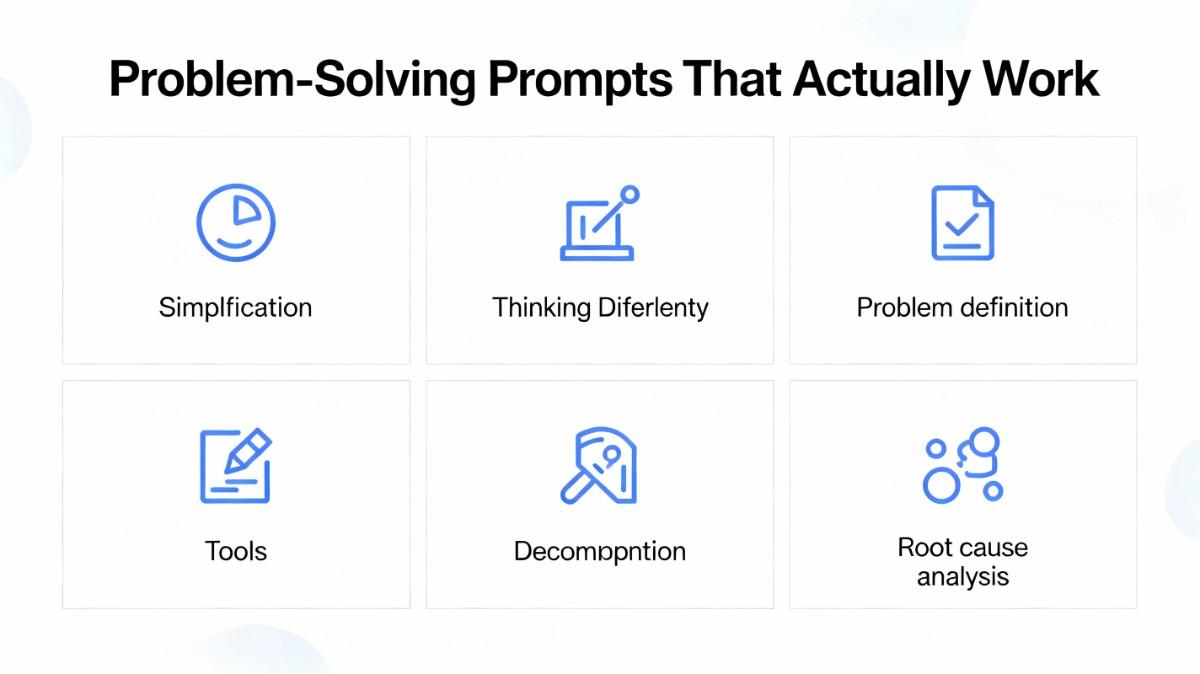
I’ve been messing around with AI for problem-solving and honestly, these prompt frameworks derived from expert quotes have helped more than I expected. Figured I’d share since they’re pretty practical.
Expert Quotes Based Problem-Solving Strategies AI Prompts Collection
1. Simplify First
George Polya: “If you can’t solve a problem, then there is an easier problem you can solve: find it.”

Prompt:
I am struggling to understand [Topic]. Create a strictly simpler version of this problem that retains the core concept, help me solve that, and then bridge it back to the original.
Alternative Prompt:
I am stuck on [Problem]. Don’t simplify it for me yet. Instead, ask me 3 guiding questions that help me strip away constraints until I arrive at the “Toy Version” of this problem myself. Once I solve the Toy Version, guide me in adding the constraints back one by one.
2. Rethink Your Thinking
Albert Einstein: “We cannot solve our problems with the same level of thinking that created them.”
Prompt:
I’ve been trying to solve [Problem] using [Current Approach], but I’m not making progress. Identify the underlying thinking patterns or mental models I might be stuck in. Then, propose three fundamentally different ways of thinking about this problem that could break me out of this loop.
Alternative Prompt:
Help me identify what assumptions I’m unconsciously making about [Problem]. Challenge each one and show me how changing that assumption could open up new solution pathways I haven’t considered.
3. State the Problem Clearly
John Dewey: “A problem well stated is a problem half solved.”
Prompt:
I think I have a problem, but I’m not sure I’m defining it correctly. Help me articulate [Situation] as a clear, specific problem statement. Ask me clarifying questions about what success looks like, what is actually broken, and what constraints are real versus perceived.
Alternative Prompt:
Here’s what I think the problem is: [Initial Description]. Using the 5 Why method, help me drill down to the actual root problem by asking “Why?” repeatedly until we reach the foundational issue.
4. Challenge Your Tools
Abraham Maslow: “If your only tool is a hammer then every problem looks like a nail.”
Prompt:
I’ve been solving this type of problem using [Tool or Method], and it’s no longer working for [Problem]. Help me map what tools I have available (technical, conceptual, relational, analytical) and identify which tool is actually best suited for this specific problem.
Alternative Prompt:
Assume the tool I’m currently using is completely unavailable. What’s a radically different tool, approach, or methodology from a completely different field that could solve [Problem]? Think cross-disciplinary.
5. Decompose and Conquer
Donald Schon: “Problem setting is a process in which we name the things to which we will attend and frame the context in which we will attend to them.”
Prompt:
This problem feels too big and complex. Help me decompose [Large Problem] into smaller, more manageable sub-problems. For each sub-problem, identify: (1) what needs to be solved, (2) dependencies on other sub-problems, and (3) which is the logical starting point.
Alternative Prompt:
Map out the system of this problem for me. Identify all the interconnected parts, feedback loops, and dependencies. Which single component, if fixed, would have the largest cascading positive effect?
6. Use the 5 Whys
Sakichi Toyoda: Root cause analysis demands we ask “Why?” until we reach the foundational issue.
Prompt:
The symptom I’m experiencing is [Symptom]. Let’s use the 5 Whys technique. Ask me “Why” and based on my answer, continue drilling down four more times until we uncover the root cause, not just the surface problem.
Alternative Prompt:
I keep getting the same problem recurring: [Problem]. Help me identify if this is a systemic issue or a one-off incident. If systemic, what’s the root cause that’s generating this repeatedly?
7. Reframe the Problem
Edward de Bono: “Most of the mistakes in thinking are inadequacies of perception rather than mistakes of logic.”
Prompt:
I’m stuck because I’ve been looking at [Problem] from one perspective. Help me reframe this problem from five different angles: (1) from a competitor’s view, (2) from a customer’s view, (3) from a future perspective, (4) from a systems perspective, and (5) from first principles. Which reframe opens up the best solutions?
Alternative Prompt:
The narrative I’ve constructed around this problem is [Narrative]. Help me deconstruct this story and reconstruct it with a completely different interpretation that might suggest different solutions.
8. Embrace Lateral Thinking
Edward de Bono: “The purpose of thinking is to stop thinking (look for a pattern, start it, stop thinking).”
Prompt:
I’m approaching [Problem] logically, but logic isn’t working. Let’s use lateral thinking. Generate ten wild, absurd, or unconventional ideas for solving this. Do not filter—we will evaluate after. The goal is to break patterns and find unexpected angles.
Alternative Prompt:
What would the opposite solution look like? If I wanted to make [Problem] worse instead of better, what would I do? Now, reverse that thinking to find novel solutions.
9. Identify Hidden Assumptions
Peter Drucker: “The most important thing to remember about management is that it’s not about the people, but about the function. The most important thing to remember about making decisions is that it’s not about choosing between right and wrong, but between possibilities.”
Prompt:
List out all the assumptions embedded in how I’ve been thinking about [Problem]. For each assumption, ask: “What if this was not true?” and explore what solutions become possible when that assumption is removed.
Alternative Prompt:
I’m assuming that [Assumption] is fixed. What would change if that assumption were negotiable or false? How would the problem transform?
10. Use Systems Thinking
Peter Senge: “Systems thinking is a discipline for seeing wholes. It is a framework for seeing interrelationships rather than things, for seeing ‘patterns of change’ rather than ‘static snapshots.'”
Prompt:
Map [Problem] as a system with feedback loops, delays, and interconnections. Identify: (1) where are the leverage points? (2) what unintended consequences might result from obvious solutions? (3) what’s the system trying to maintain in equilibrium that resists change?
Alternative Prompt:
This problem is nested in a larger ecosystem. Help me identify the boundaries of the system I’m looking at. What happens if I expand those boundaries? What becomes visible that I was missing before?
11. Challenge the Frame
Donald Schon: “The situations of practice are not problems to be solved but problematic situations characterized by uncertainty, disorder, and indeterminacy.”
Prompt:
Help me examine the frame I’ve placed around [Problem]. What am I choosing to see, and what am I choosing to ignore? If I shifted the frame to include [Neglected Element], how would that change the problem and its solutions?
Alternative Prompt:
Am I solving the right problem or just a symptom? Help me verify that the problem I’m focused on is actually the one worth solving, or is there a bigger issue underneath?
12. Analyze Root Causes Visually
Fishbone Diagram (Ishikawa): Visual cause-and-effect analysis organized by category.
Prompt:
Create a Fishbone diagram for [Problem]. Organize potential causes under: People, Processes, Materials, Equipment, Environment, and Methods. Which category has the highest concentration of likely root causes?
Alternative Prompt:
Using Pareto Analysis (eighty-twenty rule), which twenty percent of causes are likely generating eighty percent of this problem? Focus our solution efforts there first.
If you like experimenting with prompts, you might enjoy this free AI Prompts Collection, all organized with real use cases and test examples.