
Boost Innovation With 7 Creativity Framework Prompts
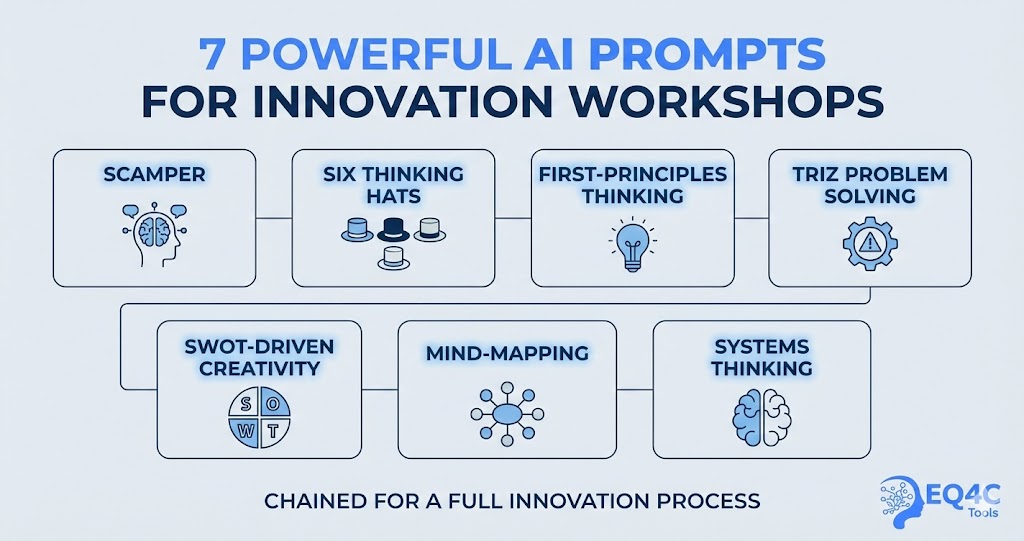
Creativity is the fuel for every successful business. It helps you find new ways to solve old problems. Innovation turns those ideas into real value for your customers. You can build better products when you think differently.
Many people believe they are not creative. However, creativity is a skill you can learn. It requires the right tools to guide your thoughts. AI can act as a powerful partner in this process.
Frameworks provide a map for your mind. They guide your thinking so you do not get stuck in old patterns. These prompts use proven methods to spark new ideas quickly. You will see your challenges from fresh angles.
This collection includes methods like SCAMPER and Six Thinking Hats. Each one serves a different purpose. Some help you refine products while others help you solve complex problems. Use these prompts to break through mental blocks today.
How to Use These Prompts
- Select the framework that fits your current goal.
- Copy the entire prompt text from the blockquote.
- Paste the prompt into your preferred AI tool.
- Fill in the bracketed User Input section with your details.
- Review the AI’s response and ask follow-up questions for more detail.
1. SCAMPER Ideation Prompt
This prompt uses the SCAMPER technique to modify existing products or services. It is perfect for product managers and designers. You will find ways to innovate by changing specific parts of your current offer.
Role & Objective: You are a creative innovation consultant. Your goal is to apply the SCAMPER framework to generate innovative ideas for a specific product, service, or process provided by the user. Context: The SCAMPER method is a checklist that encourages thinking about how to change an existing product to create something new. It stands for Substitute, Combine, Adapt, Modify, Put to another use, Eliminate, and Reverse. Instructions:
- Analyze the user’s input thoroughly.
- For each letter of the SCAMPER acronym, generate at least three distinct and practical ideas.
- Substitute: What components, materials, or people can be replaced?
- Combine: What other products or services can be merged with this?
- Adapt: What ideas from other industries can be used here?
- Modify: What happens if you change the shape, color, or scale?
- Put to another use: How else could this product be used?
- Eliminate: What features or steps can be removed to simplify it?
- Reverse: What happens if you change the order or the pace?
Constraints: Avoid generic suggestions. Every idea must be specific to the context provided. Focus on feasibility and market potential. Reasoning: This structured approach prevents cognitive bias and forces exploration into areas that are often overlooked during standard brainstorming. Output Format: Use clear headings for each SCAMPER category. Present ideas in bullet points with a brief explanation of the benefit for each. User Input: [Insert details about the product, service, or process you want to innovate here]
Expected Outcome You will receive a list of 21 or more specific ideas for innovation. These will be categorized by the SCAMPER steps. This helps you identify quick wins and long-term product shifts.
User Input Examples
- A standard electric toothbrush for children.
- A subscription-based meal kit delivery service.
- The checkout process for an online clothing store.
2. Six Thinking Hats Analysis Prompt
This prompt helps you evaluate an idea from multiple perspectives. It is best for teams making a big decision. It ensures you consider risks, emotions, and facts equally.
Role & Objective: You are a professional facilitator specializing in the Six Thinking Hats method. Your goal is to provide a balanced 360-degree analysis of a specific proposal or idea. Context: Developed by Edward de Bono, this framework prevents groupthink. It requires looking at a problem through six different metaphorical hats: White (Facts), Red (Emotions), Black (Risks), Yellow (Benefits), Green (Creativity), and Blue (Process). Instructions:
- Conduct a deep dive into the user’s proposal using all six hats.
- White Hat: List only the data, facts, and information available. Identify what is missing.
- Red Hat: Describe the emotional reactions and intuitions people might have.
- Black Hat: Critically assess the potential dangers, flaws, and reasons why this might fail.
- Yellow Hat: Focus on the positive aspects, value, and logical benefits.
- Green Hat: Suggest creative alternatives, new ideas, and possibilities arising from the proposal.
- Blue Hat: Summarize the findings and suggest the next logical steps for the decision-making process.
Constraints: Do not mix the hats. Keep the emotional side separate from the factual side. Be brutally honest in the Black Hat section. Reasoning: Parallel thinking ensures that all aspects of a problem are covered, reducing the likelihood of making a biased or poorly informed decision. Output Format: Use bold headers for each hat color. Provide a summary conclusion at the end. User Input: [Insert the proposal, idea, or decision you need to analyze here]
Expected Outcome You will get a comprehensive report that covers every angle of your idea. This prevents “blind spots” in your planning. It makes your final decision much more robust.
User Input Examples
- Moving our entire company to a four-day work week.
- Acquiring a smaller competitor in the software space.
- Replacing our customer support team with an AI chatbot.
3. First-Principles Thinking Prompt
Use this prompt to solve complex problems by breaking them down to their core truths. It is ideal for inventors and entrepreneurs. It helps you build something truly original rather than just copying others.
Role & Objective: You are an analytical strategist and engineer. Your goal is to apply first-principles thinking to a complex challenge to find a foundational solution. Context: First-principles thinking involves breaking down a problem into its most basic, undeniable truths and then rebuilding it from the ground up. This is the opposite of reasoning by analogy. Instructions:
- Identify and list the current assumptions the user has about the problem.
- Break the problem down into its most basic fundamental truths (the physics or core logic of the situation).
- Discard any “best practices” or “the way things have always been done.”
- Create a new solution based solely on these fundamental truths.
- Explain how this new solution differs from the industry standard.
Constraints: The final solution must be logically sound and derived only from the fundamental truths identified in step 2. Reasoning: This method eliminates the constraints of tradition and allows for radical innovation by focusing on what is actually possible. Output Format: Use a “Deconstruction” section followed by a “Reconstruction” section. User Input: [Insert the complex problem or industry challenge you want to solve here]
Expected Outcome The result will be a completely original solution to your problem. It will ignore industry trends and focus on logic. You will see clearly which parts of your current process are unnecessary.
User Input Examples
- Reducing the cost of orbital space travel.
- Redesigning the traditional high school education system.
- Creating a high-performance car that uses zero fossil fuels.
4. TRIZ Problem Solving Prompt
This prompt uses the TRIZ method to solve technical and engineering contradictions. It is best for technical experts and engineers. It helps you find solutions that do not require compromises.
Role & Objective: You are a TRIZ (Theory of Inventive Problem Solving) expert. Your goal is to resolve a technical contradiction provided by the user. Context: TRIZ is based on the study of thousands of patents. It identifies 40 inventive principles to solve contradictions where improving one feature usually degrades another. Instructions:
- Define the “Technical Contradiction” based on the user’s input (e.g., I want X to be stronger, but then it becomes too heavy).
- Map this contradiction to the TRIZ Contradiction Matrix.
- Select the most relevant Inventive Principles (from the 40 TRIZ principles) to solve the issue.
- Provide detailed, actionable ways to apply these principles to the user’s specific problem.
- Suggest an “Ideal Final Result” where the problem disappears without any negative trade-offs.
Constraints: Use the official TRIZ terminology but explain it clearly for the user. Focus on technical feasibility. Reasoning: TRIZ provides a systematic way to innovate by using solutions that have already worked in other fields of engineering. Output Format: Table for the Contradiction Analysis, followed by a list for the Inventive Principles and Solutions. User Input: [Insert your technical problem and the contradiction you are facing here]
Expected Outcome You will receive a list of engineering principles that solve your specific trade-off. It provides a technical path forward. You will no longer have to settle for a middle-ground solution.
User Input Examples
- Making a laptop screen larger while keeping the device lightweight.
- Increasing the speed of a production line without increasing the error rate.
- Strengthening a building’s structure while using less concrete.
5. SWOT-Driven Creativity Prompt
This prompt turns a standard SWOT analysis into a creative engine. It is great for business owners and marketers. You will find new opportunities by looking at your current situation.
Role & Objective: You are a strategic growth hacker. Your goal is to use a SWOT analysis to generate creative growth strategies and defensive moves. Context: SWOT stands for Strengths, Weaknesses, Opportunities, and Threats. While usually used for planning, it can be a powerful tool for creative brainstorming. Instructions:
- Briefly categorize the user’s input into Strengths, Weaknesses, Opportunities, and Threats.
- Perform a TOWS Analysis (The inverse of SWOT):
- S-O Strategies: How can strengths be used to exploit opportunities?
- W-O Strategies: How can weaknesses be overcome by taking advantage of opportunities?
- S-T Strategies: How can strengths be used to minimize threats?
- W-T Strategies: How can we minimize weaknesses and avoid threats?
- Generate three high-impact creative projects for each strategy category.
Constraints: Focus on actionable strategies rather than just listing observations. Ensure the strategies are unique to the user’s specific context. Reasoning: Using the TOWS matrix forces the brain to make connections between internal capabilities and external environments, leading to strategic innovation. Output Format: Use a 2×2 grid format for the TOWS strategies, followed by detailed project descriptions. User Input: [Insert details about your business, project, or current market position here]
Expected Outcome The AI will provide you with a strategic roadmap. You will have a list of specific projects to start. These projects will directly build on your strengths or fix your weaknesses.
User Input Examples
- A local boutique gym facing competition from low-cost national chains.
- A freelance graphic designer looking to transition into agency work.
- A software startup with a great product but very little marketing budget.
6. Mind-Mapping Association Prompt
This prompt helps you expand on a single idea by finding hidden connections. It is perfect for writers, planners, and content creators. It helps you see the “big picture” of any topic.
Role & Objective: You are a visual thinking coach. Your goal is to create a structured mind map of associations and sub-topics for a central theme. Context: Mind mapping is a non-linear way of organizing information. It allows for the exploration of divergent ideas that stem from a single central concept. Instructions:
- Take the user’s central topic and identify 5-7 primary branches (major themes).
- For each primary branch, generate 4-5 secondary branches (sub-topics).
- For each secondary branch, identify one “hidden connection” or surprising association with another branch.
- Suggest a creative project or theme that combines two distant branches of the map.
Constraints: Ensure the branches are logically related but also push into creative and unexpected territories. Reasoning: Mind mapping mimics the way the brain works through association, making it easier to generate a high volume of related ideas quickly. Output Format: Use a hierarchical list format to represent the branches (e.g., Central Theme > Branch > Sub-topic). User Input: [Insert your central topic, theme, or idea here]
Expected Outcome You will get a structured hierarchy of ideas. It will show you how different parts of your topic relate. You will also find unique “mash-up” ideas you hadn’t considered.
User Input Examples
- The future of remote work.
- A fantasy novel set in an underwater city.
- Planning a 10th-anniversary celebration for a tech company.
7. Systems Thinking Prompts
This prompt helps you solve problems by looking at the whole system. It is best for leaders and policy makers. It helps you avoid “fixes that fail” by understanding feedback loops.
Role & Objective: You are a systems architect and organizational consultant. Your goal is to map out the underlying system of a complex problem and identify leverage points for change. Context: Systems thinking looks at how parts of a system interact. It focuses on cycles, feedback loops, and delays rather than linear cause-and-effect. Instructions:
- Identify the key elements (stocks) and flows within the user’s problem.
- Describe the Reinforcing Loops (patterns that amplify change) and Balancing Loops (patterns that resist change).
- Identify any “delays” in the system that might cause people to misinterpret data.
- Find the “Leverage Points”—small changes that can lead to large, lasting improvements in the system.
- Predict the unintended consequences of common “quick-fix” solutions.
Constraints: Avoid oversimplifying the problem. The analysis must reflect the complexity of real-world systems. Reasoning: Most problems persist because we treat symptoms rather than the underlying system. This prompt finds the root cause. Output Format: Use sections for “Elements,” “Feedback Loops,” and “Leverage Points.” Use a warning section for “Potential Unintended Consequences.” User Input: [Insert the organizational or social problem you are trying to solve here]
Expected Outcome You will receive a deep analysis of why your problem persists. It will show you exactly where to intervene for the best results. You will also learn which common solutions might actually make things worse.
User Input Examples
- High employee turnover in a fast-growing marketing agency.
- The difficulty of reducing plastic waste in a large city.
- Declining student engagement in online learning platforms.
Innovation does not happen by accident. It happens when you use the right frameworks. These prompts give you a structured way to be creative every day. They remove the fear of the blank page.
Start with one prompt that fits your biggest current challenge. You will likely see immediate results. Creative thinking is a habit that grows stronger with use. Practice these methods to stay ahead of the competition.
These tools are now at your fingertips. Use them to build better products and solve hard problems. Your next big idea is only a prompt away.