
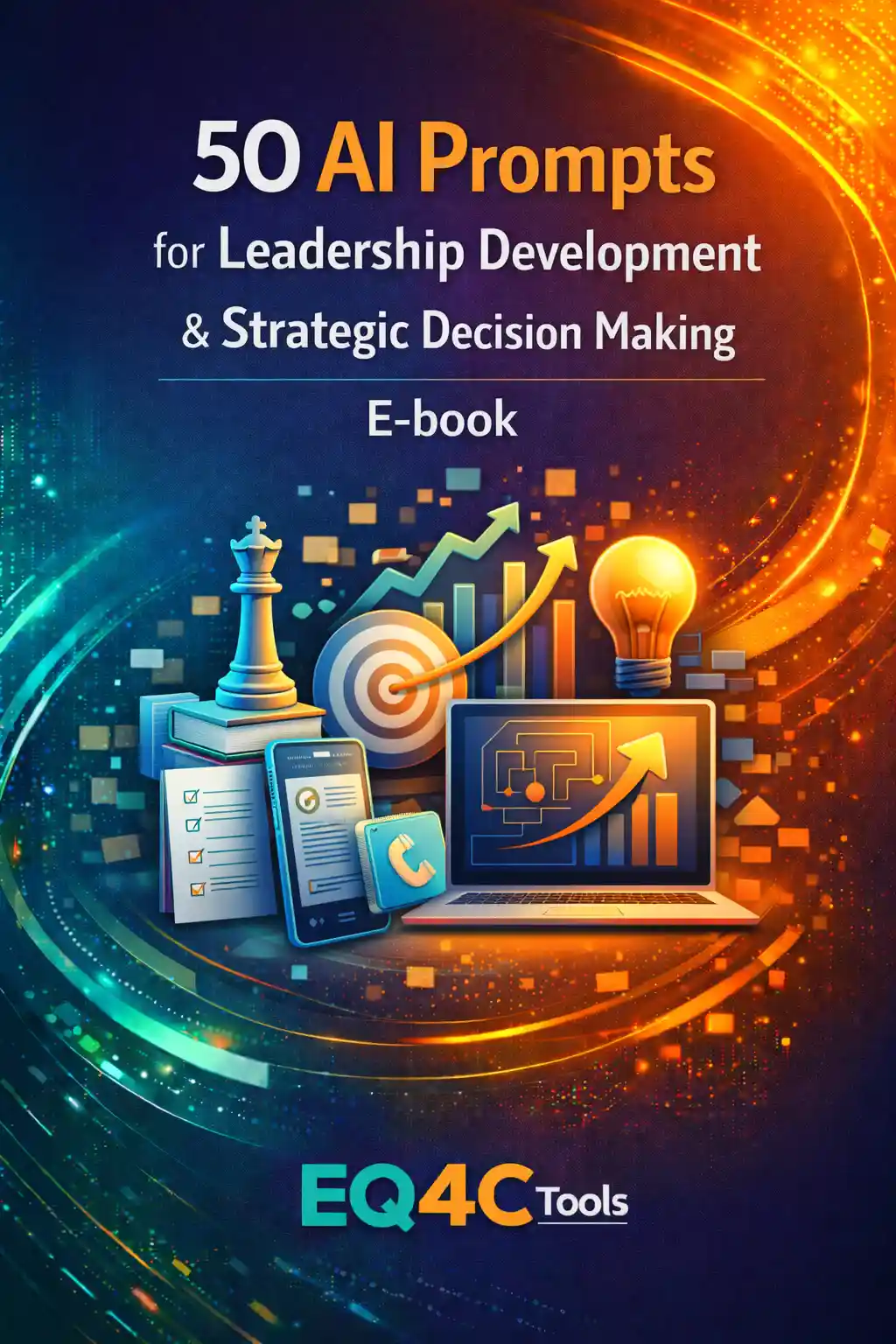
E-book: 50 AI Prompts for Leadership Development & Strategic Decision Making
Original price was: $12.99.$5.99Current price is: $5.99.
Exhaustive collection of 50 ChatGPT prompts for leadership covering emotional intelligence, strategic thinking, team management, decision-making, change management, and more. Ready-to-use templates for every leadership challenge.
Description
Leadership demands more than traditional management skills. Leaders must learn and implement AI-driven transformation, manage diverse global teams, make decisions under uncertainty, and foster cultures of innovation and psychological safety.
Table of Contents
- Introduction
- How to Use These Leadership Prompts
- Category 1: Emotional Intelligence & Self-Awareness (8 Prompts)
- Category 2: Team Leadership & Management (8 Prompts)
- Category 3: Strategic Thinking & Decision Making (8 Prompts)
- Category 4: Change Management & Adaptability (8 Prompts)
- Category 5: Communication & Influence (8 Prompts)
- Category 6: Conflict Resolution & Stakeholder Management (6 Prompts)
- Category 7: Innovation & Vision Setting (6 Prompts)
- Conclusion & Next Steps
Introduction
This comprehensive prompt collection provides 50+ carefully structured AI prompts designed to address every dimension of modern leadership:
- Leading Yourself: Emotional intelligence, self-awareness, resilience, continuous learning
- Leading Others: Team dynamics, motivation, coaching, performance management, inclusivity
- Leading the Organization: Strategic vision, change management, innovation, stakeholder alignment
- Leading in Uncertainty: Decision-making under pressure, AI integration, adaptive strategy, crisis management
Each prompt is structured using proven frameworks: Role & Objective, Context, Instructions, Constraints, Reasoning, Output Format, and User Input. This scientific approach ensures consistent, actionable insights regardless of your specific leadership challenge.
How to Use These Leadership Prompts
Step-by-Step Guide
Step 1: Identify Your Leadership Challenge
Review the categories and prompts below to find those most relevant to your current situation. Whether you are developing emotional intelligence, managing a difficult team transition, or setting organizational strategy, there is a prompt designed for your specific need.
Step 2: Understand the Prompt Structure
Each prompt follows a consistent architecture:
- Prompt Title: Clear, outcome-focused description of what the prompt delivers
- Use Case Intro: Practical context showing when and why you would use this prompt
- Prompt: The complete prompt configuration with underlying framework tags embedded
- Expected Outcome: What insight, strategy, or plan you should receive from using this prompt
- User Input Examples: Three realistic scenarios showing how different leaders might apply this prompt
Step 3: Customize for Your Context
While these prompts are immediately usable, maximum value comes from customization. Replace generic organizational references with your actual company name. Insert real team member names, specific business challenges, and precise timeline expectations. The more contextual detail you provide, the more tailored and actionable the AI output becomes.
Step 4: Iterate and Refine
Use the AI output as a starting point for deeper thinking. If a response feels incomplete, follow up with clarifying questions. Ask for alternative perspectives, deeper analysis, or different frameworks. The most powerful insights often emerge through iterative dialogue.
Step 5: Implement and Track Results
Do not file these outputs away. Implement recommendations, track results, and revisit prompts after 30-60 days to assess impact. This creates a virtuous cycle of leadership improvement and organizational learning.
Step 6: Build Your Leadership Prompt Library
Save prompts that prove most valuable for your leadership style and organizational context. Over time, you will develop a personalized library of go-to prompts for recurring leadership challenges
Step 3: Customize for Your Context
While these prompts are immediately usable, maximum value comes from customization. Replace generic organizational references with your actual company name. Insert real team member names, specific business challenges, and precise timeline expectations. The more contextual detail you provide, the more tailored and actionable the AI output becomes.
Step 4: Iterate and Refine
Use the AI output as a starting point for deeper thinking. If a response feels incomplete, follow up with clarifying questions. Ask for alternative perspectives, deeper analysis, or different frameworks. The most powerful insights often emerge through iterative dialogue.
Step 5: Implement and Track Results
Do not file these outputs away. Implement recommendations, track results, and revisit prompts after 30-60 days to assess impact. This creates a virtuous cycle of leadership improvement and organizational learning.
Step 6: Build Your Leadership Prompt Library
Save prompts that prove most valuable for your leadership style and organizational context. Over time, you will develop a personalized library of go-to prompts for recurring leadership challenges.
Sample Prompt (All 50 prompts follow the same mega-prompt structure):
Category 1: Emotional Intelligence & Self-Awareness
Emotional intelligence remains the primary differentiator between good leaders and exceptional ones. These eight prompts develop the four core pillars of EI: self-awareness, self-regulation, empathy, and relationship management.
Prompt 1: Emotional Intelligence Assessment & Development Plan
Prompt Title: Create My Personalized Emotional Intelligence Development Plan
Use Case Intro: You want to understand your current emotional intelligence strengths and gaps, then design a structured 90-day development plan focusing on the areas that will have the greatest impact on your leadership effectiveness.
Prompt:
You are an executive coach specializing in emotional intelligence development for senior leaders. Your role is to help leaders conduct a comprehensive self-assessment and create a targeted development plan.
I am a [LEADERSHIP_LEVEL] leader at a [ORGANIZATION_TYPE] company with [YEARS_EXPERIENCE] years of leadership experience. My primary leadership challenge is [SPECIFIC_CHALLENGE].
I want you to:
- Assess my likely strengths and development areas across the four pillars of emotional intelligence: self-awareness, self-regulation, empathy, and relationship management
- Identify which two pillars would have the greatest impact on solving my stated leadership challenge
- For each of these two pillars, suggest three specific, measurable development activities
- Create a 90-day implementation timeline with weekly milestones and reflection checkpoints
- Suggest metrics and indicators that will help me track progress and measure improvement
Create a structured plan that is realistic, actionable, and designed for a busy executive. Prioritize activities that can be integrated into existing leadership responsibilities rather than requiring additional time commitments.
Expected Outcome: A personalized, 90-day emotional intelligence development plan with specific activities, weekly milestones, measurement metrics, and integration strategies for your actual work context. This plan moves beyond generic EI training to target your specific leadership challenges.
User Input Examples:
Example 1: I am a newly promoted VP of Operations with 12 years of management experience at a manufacturing company. My primary leadership challenge is managing my frustration during difficult team meetings and delegating effectively. I tend to take over when things are not moving fast enough.
Example 2: I am a CEO with 20 years of leadership experience at a technology startup experiencing hypergrowth. My primary leadership challenge is maintaining authentic connection with teams as the organization scales from 50 to 500 people. I fear becoming distant and losing the culture we built.
Example 3: I am a department head with 8 years of management experience in higher education. My primary leadership challenge is managing my defensiveness when receiving critical feedback and helping my team see failure as learning rather than defeat.
Free for lifetime members, annual and monthly members
Only logged in customers who have purchased this product may leave a review.
Related products
-
Sale!
E-book: 58 ChatGPT Prompts for Hospitality and Tourism: Complete AI Guide for Hotels, Restaurants, and Travel Agencies
Original price was: $12.99.$4.99Current price is: $4.99. -
Sale!

E-book: 40 Essential AI Prompts for Food & Beverage Professionals and Restaurants
Original price was: $12.99.$5.99Current price is: $5.99. -
Sale!

E-book: 60 Google Gemini Photo Generation Prompts for Travel Content Creators: Pinterest, Blog Headers, Instagram, Itineraries & More
Original price was: $12.99.$5.99Current price is: $5.99. -
Sale!

E-book: 60 AI Prompts for Digital Marketing: Ultimate Collection to 10x Your Content Output
Original price was: $9.99.$4.99Current price is: $4.99.
Reviews
There are no reviews yet.