
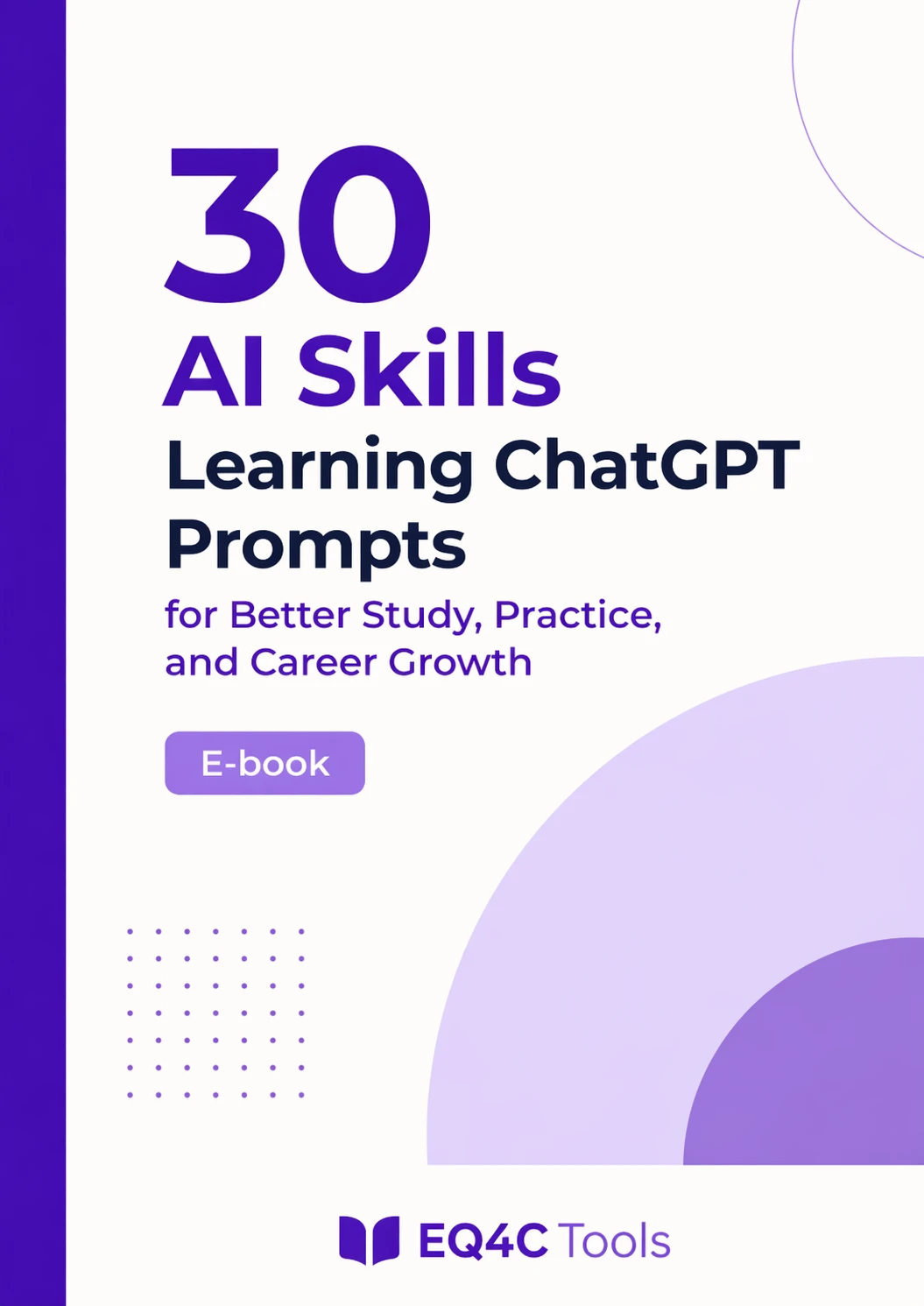
E-book: 30 AI Skills Learning ChatGPT Prompts for Better Study, Practice, and Career Growth
Original price was: $12.99.$5.99Current price is: $5.99.
Explore 30 well-categorized AI skills learning ChatGPT prompts for planning, practice, research, productivity, and career growth. Ready to copy and use.
Free for Lifetime Members, Annual and Monthly Members
Description
AI can help you learn faster, practice better, and think more clearly, but only when your prompts are specific enough to guide the model toward useful output.
This prompt collection is designed for students, self-learners, professionals, creators, and anyone who wants to use ChatGPT or similar AI tools to build skills with more structure and less guesswork.
This e-book organizes AI skills learning prompts across the full learning cycle: identifying what to learn, building study plans, understanding difficult concepts, practicing deliberately, verifying knowledge, improving retention, creating workflows, and turning learning into visible outcomes.
Each prompt includes a simple title, a brief use case, a ready-to-copy prompt, the expected outcome, and three user input examples.
The prompts are written to work across a wide range of learning goals, including technical skills, communication skills, business skills, research skills, and creative skills.
You can use them as-is or adapt them for ChatGPT, Claude, Gemini, Perplexity, or other AI assistants.
What This Collection Includes
- AI learning foundations prompts.
- Prompt writing and prompt improvement prompts.
- Learning roadmap and study planning prompts.
- Concept understanding and explanation prompts.
- Practice, retention, and assessment prompts.
- Research, verification, and comparison prompts.
- Productivity and workflow prompts.
- Teaching, communication, and creation prompts.
- Career and portfolio prompts.
- Safety, privacy, and advanced workflow prompts.
How to Use These Prompts
- Pick one prompt based on your immediate need, not your overall goal. If you are confused, start with roadmap or concept prompts.
- Replace the user input placeholders with your real topic, current level, goal, timeline, and constraints.
- Run the prompt once, review the result, and identify what is still too broad, too generic, or too advanced.
- Re-run the same prompt with tighter context, such as your background, available time, budget, audience, or output preference.
- Save useful outputs into notes, a document, or a project tracker so you can build on earlier responses instead of starting over.
- Combine prompts across categories. For example, use a roadmap prompt first, then a concept prompt, then a quiz prompt, then a project prompt.
Sample category and prompt to try:
Category: AI Learning Foundations
These prompts help define the learning target before you spend time on study materials or practice. Use them to clarify what a skill includes, what the prerequisites are, and how different AI tools can support the process.
Skill Map Builder
Brief Use Case Intro: Use this when you want to break a skill into fundamentals, sub-skills, tools, and outcomes before starting to learn it.
Prompt:
Role & Objective: Act as an expert learning strategist and skill decomposition coach. Help me map a skill from beginner level to practical competence.

Context: I want to learn a skill but need a clear breakdown of what the skill actually includes, how the parts connect, and what should be learned first.

Instructions:

Break the skill into major areas and sub-skills.
Identify prerequisites, core concepts, tools, and practical applications.
Separate must-learn essentials from nice-to-have advanced topics.
Show the logical order for learning the sub-skills.
Mention common beginner misconceptions.
Constraints: Keep the explanation practical, non-academic, and beginner-friendly. Avoid vague advice and avoid assuming prior knowledge unless I provide it.

Reasoning: Prioritize high-leverage fundamentals first, then supporting skills, then advanced layers.

Output Format: Return: skill overview, sub-skill tree, prerequisite list, learning order, and common mistakes. Do not print the internal planning labels in the final answer.

User Input: Skill: [insert skill] Current Level: [beginner/intermediate] End Goal: [insert goal] Context: [why you want to learn it]
Expected Outcome:
A clear skill map that shows what to learn, in what order, and why each part matters.
Three User Input Examples:
1. Skill: SQL for business analysis | Current Level: Beginner | End Goal: Build dashboards and answer business questions | Context: I work in operations
2. Skill: Copywriting | Current Level: Beginner | End Goal: Write landing pages and email campaigns | Context: I manage a small brand
3. Skill: Python for data analysis | Current Level: Intermediate | End Goal: Clean data and automate reports | Context: I already know spreadsheets
Download the Collection Now!!
Only logged in customers who have purchased this product may leave a review.
Related products
-
Sale!
E-book: 35 AI Prompt Collection for Lawyers and Paralegals to Streamline Legal Practice
Original price was: $12.99.$5.99Current price is: $5.99. -
Sale!

E-book: 60 AI Prompts for Digital Marketing: Ultimate Collection to 10x Your Content Output
Original price was: $9.99.$4.99Current price is: $4.99. -
Sale!

E-book: 85 ChatGPT Prompts for Lead Generation: The Complete Collection
Original price was: $12.99.$5.99Current price is: $5.99. -
Sale!
E-Book: 90 ChatGPT Mega-Prompts to Supercharge Business Growth and Drive Real Results
Original price was: $12.99.$5.99Current price is: $5.99.
Reviews
There are no reviews yet.