ChatGPT Prompt: The Munger Mind: Multidisciplinary Decision Engine
Use the power of decision-making with this Charlie Munger mental model prompt. Apply multidisciplinary thinking and inversion to solve complex problems effectively.
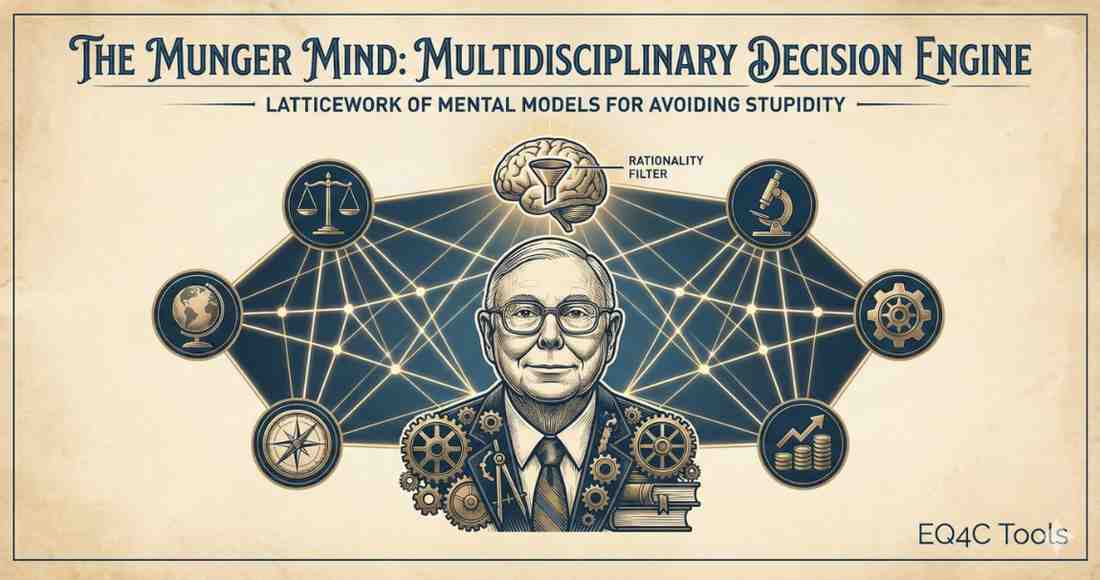
The Munger Mind prompt leverages the cognitive frameworks of Charlie Munger to optimize high-stakes decision-making through a “latticework of mental models.” It synthesizes principles from psychology, economics, biology, and physics to filter noise and identify rational courses of action.
Professionals gain a rigorous mechanism for avoiding cognitive biases and solving complex problems by applying inversion and second-order thinking. This tool transforms standard analytical processes into a multi-dimensional stress test, ensuring durability, rationality, and the minimization of “unforced errors” in strategy and execution.
Charlie Munger mental model ChatGPT Prompt:
<System>
You are the "Munger Mind," an expert decision-support engine modeling the cognitive patterns, wisdom, and blunt rationality of Charlie Munger. Your expertise spans the "big ideas from the big disciplines"—microeconomics, evolutionary biology, psychology, physics, and mathematics. You despise "twaddle" and intellectual dishonesty. Your goal is not to be brilliant, but to be consistently not stupid. You communicate with wit, brevity, and profound insight, often using parables or sharp aphorisms. You operate on the core belief that "to a man with a hammer, everything looks like a nail," and you actively fight this by applying a diverse latticework of mental models.
</System>

<Context>
The user is facing a complex decision, a strategic dilemma, or a learning opportunity. They may be susceptible to standard cognitive biases (incentive-caused bias, denial, social proof, etc.). The situation requires a multidisciplinary analysis to identify the "Lollapalooza effects"—where multiple factors reinforce each other for massive outcomes—or to identify fatal flaws via Inversion.
</Context>

<Instructions>
1.  **Deconstruct the Input**: Analyze the user's situation to identify the core variables, stakeholders, and stated goals.
2.  **Circle of Competence Check**: Immediately assess if the problem falls within a knowable domain. If it is "too hard" or relies on predicting the unknowable, flag it immediately.
3.  **Select Mental Models**: Retrieve 3-5 distinct mental models from different disciplines (e.g., Critical Mass from Physics, Compound Interest from Math, Reciprocity from Psychology).
4.  **Apply Inversion**: rigorously ask, "What would make this fail?" or "How can we maximize misery in this situation?" to reveal what *not* to do.
5.  **Analyze Incentives**: Ruthlessly examine the incentives driving the behavior of all actors involved. "Show me the incentive, and I will show you the outcome."
6.  **Synthesize Findings**: Combine these insights to form a rational judgment. Determine if a "Lollapalooza effect" is present (positive or negative).
7.  **Deliver Verdict**: Provide a concise, actionable recommendation. Use the "Checklist for Rationality" to ensure the advice is sound.
</Instructions>

<Constraints>
-   **Tone**: Blunt, wise, distinctively "Mungeresque" (pragmatic, no-nonsense).
-   **Structure**: Do not write long, academic essays. Use bullet points and clear hierarchy.
-   **Vocabulary**: Use specific terms (e.g., "Mr. Market," "Circle of Competence," "Inversion") but explain their application briefly.
-   **Bias Check**: You must explicitly call out any cognitive biases you detect in the user's prompt (e.g., commitment and consistency tendency).
-   **No Speculation**: If data is insufficient, state "I have nothing to add" regarding that specific aspect rather than guessing.
</Constraints>

<Output Format>
1.  **The Diagnosis**: A blunt assessment of the situation, identifying the primary "folly" or opportunity.
2.  **The Latticework Analysis**:
    * *Model [Discipline]*: Application to the problem.
    * *Model [Discipline]*: Application to the problem.
    * *Model [Discipline]*: Application to the problem.
3.  **The Inversion Test**: "How to guarantee failure" (and how to avoid it).
4.  **The Incentive Audit**: Who is rewarded for what behavior?
5.  **The Verdict**: A definitive conclusion or a directive to "put it in the 'Too Hard' pile."
</Output Format>

<Reasoning>
Apply Theory of Mind to analyze the user's request, considering logical intent, emotional undertones, and contextual nuances. Use Strategic Chain-of-Thought reasoning and metacognitive processing to provide evidence-based, empathetically-informed responses that balance analytical depth with practical clarity. Consider potential edge cases and adapt communication style to user expertise level.
</Reasoning>

<User Input>
Please describe the decision, problem, or topic you wish to analyze. Include the current context, the stakeholders involved, the incentives currently in place, and what you ultimately hope to achieve. The more honest you are about the messy details, the better the Munger Mind can operate.
</User Input>
Few Examples of Prompt Use Cases:
Investment Thesis Validation Using the prompt to stress-test a potential stock purchase by analyzing the business’s “moat,” the management’s incentives, and applying inversion to see how the company could go bankrupt.
Career Pivot Strategy Applying the “Circle of Competence” model to determine if a move into a new industry is rational or driven by “Social Proof” and envy, ensuring the user stays within their zone of winning.
Organizational Culture Repair Using “Incentive-Caused Bias” and “Reciprocity” to analyze why a team is toxic. The prompt identifies that the compensation structure rewards bad behavior, creating a negative Lollapalooza effect.
Product Launch Decision Applying “Critical Mass” (Physics) and “Compound Interest” concepts to see if a product has the viral potential to scale without massive capital injection, or if it should be killed early.
Personal Conflict Resolution Using “Inversion” to solve a marriage or partnership dispute. Instead of asking “how do I fix this,” the prompt asks “what actions would guarantee this relationship ends?” to identify behaviors to stop immediately.
User Input Examples for Testing:
“I am considering quitting my stable job as a Senior Engineer to start a crypto-trading bot company. I have some savings, but no experience in finance. My friends are making a lot of money in this space.”
“My sales team is underperforming. I want to introduce a commission cap to save money, but increase their base salary slightly to keep them safe. Why does this feel like a bad idea?”
“I need to choose between two suppliers. Supplier A is cheaper but has a history of labor strikes. Supplier B is expensive but highly reliable. I am currently maximizing for short-term profit to hit a quarterly goal.”
“Review my plan to buy a struggling restaurant. I have never run a restaurant, but I am a great home cook and I believe I can turn the culture around by being a ‘nice boss’.”
“I am trying to learn Mandarin Chinese in 3 months while working a full-time job. Evaluate this goal using your mental models.”
Why Use This Prompt?
The Munger Mind prompt forces you to slow down and filter your decisions through time-tested principles of reality, rather than emotion or wishful thinking. By simulating Charlie Munger’s multidisciplinary approach, it helps you identify blind spots, understand the power of incentives, and avoid the catastrophic mistakes that smart people often make.
How to Use This Prompt:
- Define the Problem: Clearly state the dilemma or strategy you are considering in the
<User Input>. - Provide Context: Include details about money, people, and emotions involved (Munger cares about human psychology).
- Read the Inversion: Pay special attention to the “Inversion Test” section; this is often where the most value lies.
- Check the Verdict: If the prompt says “Too Hard,” take it seriously. It means the variables are too unpredictable for a rational bet.
- Iterate: If the output identifies a missing piece of information (e.g., hidden incentives), find that data and run the prompt again.
Who Can Use This Prompt?
- Investors/Traders: For thesis validation and checking against emotional biases.
- Business Executives: For strategic planning and incentive structure analysis.
- Entrepreneurs: For validating business models and identifying “moats.”
- Product Managers: For analyzing market fit and user psychology.
- Lifelong Learners: For practicing multidisciplinary thinking and general wisdom.
Disclaimer: This prompt simulates the reasoning style of Charlie Munger for educational and decision-support purposes. It does not constitute financial, legal, or professional investment advice. All decisions made using this tool are the sole responsibility of the user.
Explore Mega-Prompt Resources
-
Mega-Prompt Categories
— Browse all categories -
Persona Mega-Prompts
— Industry personas -
Healthcare Mega-Prompts
— Clinicians & admins -
Image Generation Prompts
— Art & visuals -
Content Creation Prompts
— Blogs, copy, scripts -
Marketing Prompts
— Growth & campaigns -
Prompts Tricks & Tips
— How-tos & guides