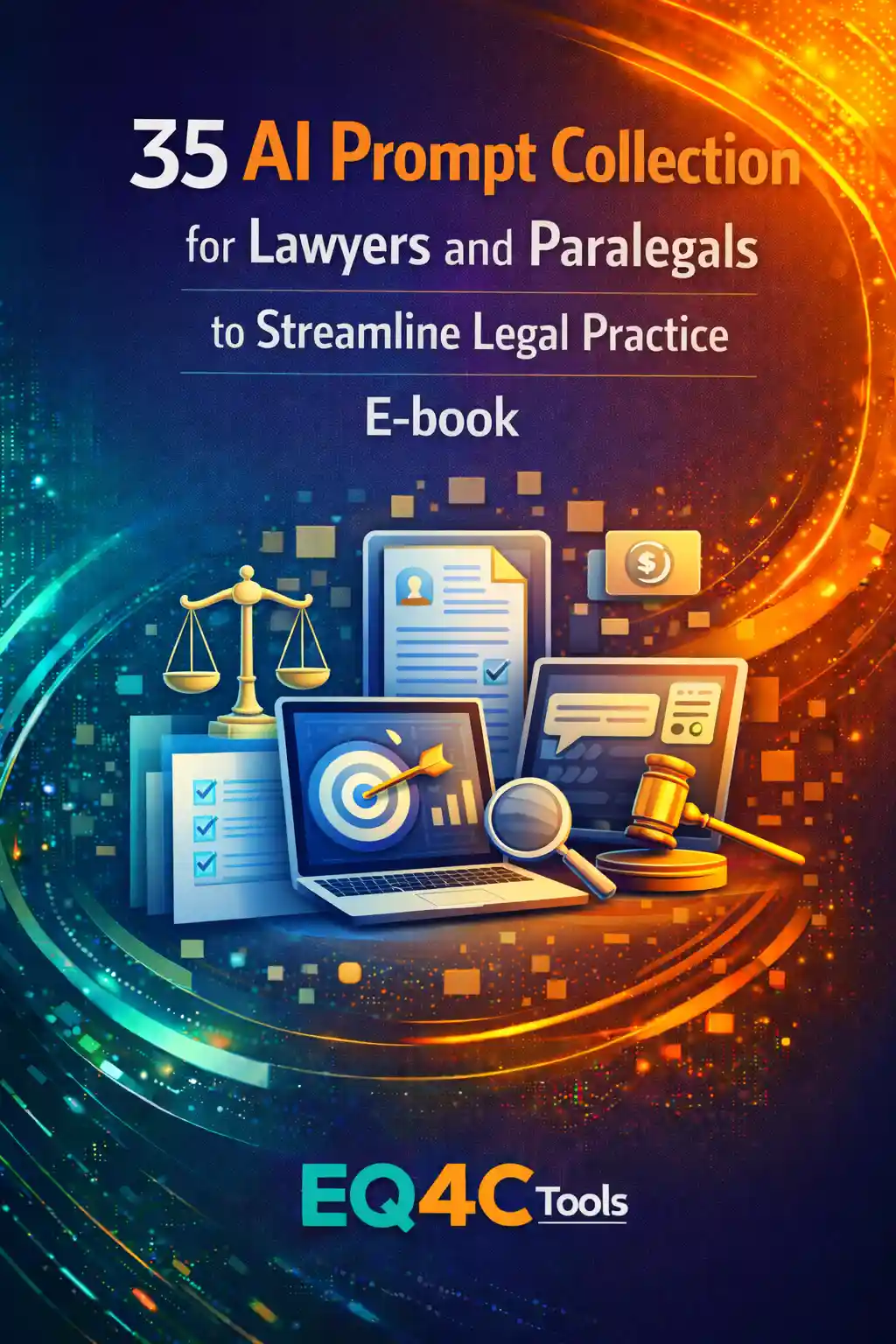
This comprehensive e-book contains 35 carefully structured AI prompts designed specifically for lawyers and paralegals. Each prompt is engineered using proven prompt engineering techniques including role-based personas, contextual framing, clear constraints, and structured output formats.
Sale!
E-book: 35 AI Prompt Collection for Lawyers and Paralegals to Streamline Legal Practice
Original price was: $12.99.$5.99Current price is: $5.99.
Legal professionals face mounting pressure to do more with less. Case management, legal research, contract drafting, and client communication consume hours each day. Generative AI tools like ChatGPT have emerged as powerful allies, but only when you know how to ask the right questions.
This comprehensive guide contains 35 carefully structured AI prompts designed specifically for lawyers and paralegals. Each prompt is engineered using proven prompt engineering techniques including role-based personas, contextual framing, clear constraints, and structured output formats.
Unlike generic AI prompts, these templates are built to handle the specific challenges of legal practice. Whether you are summarizing case law, identifying contract risks, drafting legal correspondence, or preparing litigation strategy, you will find field-tested prompts that deliver actionable results.
What Makes These Prompts Different
These prompts incorporate five key elements of effective prompt engineering for legal professionals:
- Personas: Each prompt assigns a specific role or expertise level to establish appropriate tone and depth
- Context: Detailed background information that frames the legal issue and defines scope
- Clear Instructions: Step-by-step guidance that tells AI exactly what to do and in what format
- Constraints: Defined boundaries around legal standards, jurisdiction, and confidentiality
- Structured Output: Specific formatting requirements that ensure usable, professional-grade results
Prompt Categories Covered
Category 1: Legal Research and Case Analysis
Category 2: Contract Management and Drafting
Category 3: Legal Writing and Documentation
Category 4: Client Communication and Management
Category 5: Litigation Support and Case Strategy
Category 6: Compliance and Risk Analysis
Category 7: Administrative and Workflow Automation
How to Use These Prompts Effectively
Step-by-Step Usage Guide
Step 1: Choose Your Prompt Based on Your Need
Review the categories below and identify the prompt that matches your specific task. Each category organizes prompts by common legal workflows and practice areas.
Step 2: Copy the Entire Prompt
When you locate a prompt, copy the complete text from the blockquote section. This includes all role information, context, instructions, constraints, and output format specifications. Do not skip sections.
Step 3: Customize Input Variables
Look for bracketed placeholders like [CASE NAME] or [DOCUMENT TYPE]. Replace these with your specific information. Customize without changing the prompt structure or instructions.
Step 4: Paste Into Your AI Tool
Open ChatGPT, Claude, Gemini, or your legal AI platform of choice. Paste the complete customized prompt into the chat window.
Step 5: Review and Refine
Review the AI output for accuracy and completeness. If the response is incomplete, ask follow-up questions or use sequential prompting by asking the AI to expand on specific sections.
Step 6: Quality Check and Attribution
Always verify AI-generated legal content for accuracy. Never use AI output without attorney review. Ensure compliance with confidentiality obligations before processing client information.
Best Practices for Legal AI Prompting
- Always include jurisdiction: Specify applicable state, federal, or international law
- Define document type precisely: State the specific contract or document being addressed
- Provide relevant context: Include case facts, timeline, and party relationships
- Set appropriate constraints: Clarify confidentiality, tone, and professional standards
- Request structured output: Ask for numbered lists, tables, or sections for clarity
- Follow up with detail questions: Use sequential prompting to deepen analysis or expand sections
Sample Prompt to Try
Prompt 1: Case Law Summary and Key Holdings Extraction
Prompt Title: Extract Case Summary With Key Holdings and Practical Application
Use Case Intro:
You need a clear, structured summary of a court decision without reading through dozens of pages. This prompt asks the AI to extract essential holdings, reasoning, and practical implications from any case description or full case text.
Prompt:
You are an experienced legal researcher specializing in [PRACTICE AREA] law with 15 years of experience preparing case summaries for attorney and client consumption.
I am providing you with information about a [STATE/FEDERAL] court case called [CASE NAME]. I need a professional case summary that explains what the court decided and why.
Analyze the case and provide the following:
- Case Citation and Court (where decided, year)
- Parties Involved (plaintiff and defendant, brief identifying information)
- Relevant Facts (what happened that led to the lawsuit, organized chronologically)
- Legal Issue(s) (the specific legal question or questions the court had to decide)
- Court Decision (what the court ruled and by what vote or margin)
- Legal Reasoning (why the court made this decision, key legal principles applied)
- Key Holdings (the specific legal rule or principle established by this case)
- Practical Impact (how this ruling affects similar cases, businesses, or individuals)
- Potential Challenges (any subsequent appeals, modifications, or challenges to this ruling)
- Application to Current Issues (how this case might apply to [SPECIFIC SCENARIO])
Format your response using numbered sections matching above. Use plain language while maintaining legal precision. Keep each section 2-4 sentences maximum except Legal Reasoning which may be longer. Highlight any holdings or principles in bold.
Case Information: [PASTE CASE TEXT OR CASE DESCRIPTION HERE]
Expected Outcome:
A structured, 1-2 page case summary with clear identification of holdings, reasoning, and practical application. Output suitable for attorney review, client explanation, or research compilation.
User Input Examples:
- A recent appellate decision on contract interpretation in your practice area
- A landmark case on privacy rights affecting employment law
- A district court ruling on commercial lease disputes that you need to apply to a current client matter
For entire collection, download now
Free for Lifetime Members, Annual and Monthly Members
Only logged in customers who have purchased this product may leave a review.
Related products
-
Sale!

Ebook: 66 AI Prompts in 16 Sub-categories to Scale Your Affiliate Business
Original price was: $15.99.$5.99Current price is: $5.99. Add to cart -
Sale!
Ebook: 70 Essential AI Prompts for Education: Comprehensive Guide for All Learning Contexts
Original price was: $9.99.$4.99Current price is: $4.99. Add to cart -
Sale!
E-book: 50 AI Prompts for Leadership Development & Strategic Decision Making
Original price was: $12.99.$5.99Current price is: $5.99. Add to cart
Reviews
There are no reviews yet.