Copywriting is the art of writing to sell. It helps businesses reach new customers. Good words can change how people think about a product. This skill is vital for any brand today.
Modern marketing moves very fast. You need clear messages to stand out. Copywriting connects your product to the right audience. It builds trust and encourages people to take action.

This guide focuses on the best ways to write copy. We will look at how AI can help you. These prompts will save you time and improve your results.
High-Impact Advertising Copy
Advertising copy is a specific type of writing. It is usually short and very direct. The goal is to get a quick response from the reader. This includes ads on social media or physical posters.
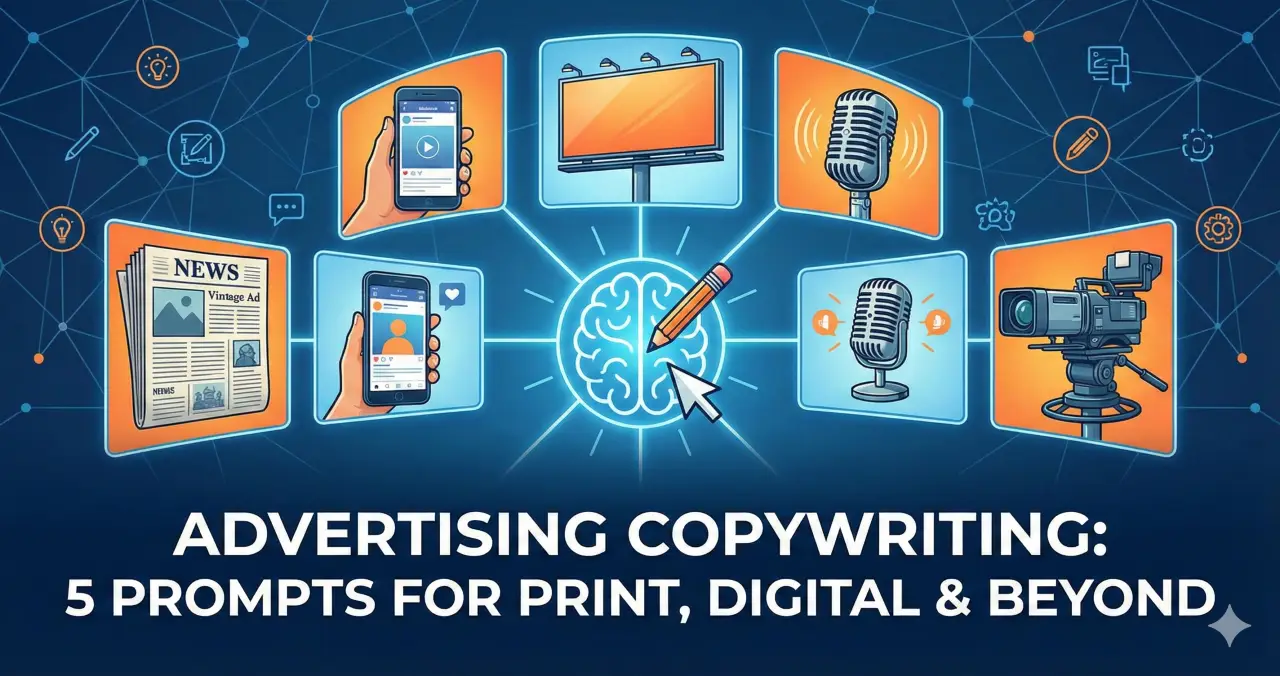
In this section, we cover five key use cases. You will find prompts for print, digital, and outdoor ads. We also include scripts for radio and television. These tools cover every major advertising channel.
Using these prompts helps you maintain a consistent voice. You can create many versions of an ad in seconds. This allows you to test what works best for your brand.
How to Use These Prompts
- Select the specific use case that fits your current project.
- Copy the text inside the blockquote for that section.
- Paste the prompt into your preferred AI chat tool.
- Fill in the bracketed information with your specific product details.
- Review the results and ask the AI for small changes if needed.
1. Print Advertising Copy
This prompt creates text for physical media like magazines or newspapers. It helps you organize headlines and body text for a professional layout. This solves the problem of trying to fit too much information into a small space.
You are a Senior Print Copywriter with twenty years of experience in high-end magazine advertising. Your goal is to produce a compelling print advertisement that balances visual storytelling with persuasive text. You will receive specific details about a product and its target audience. Use this information to create a structured ad layout. First, analyze the target demographic and the publication where the ad will appear. Second, craft a bold, punchy headline that stops a reader from turning the page. Third, write a concise body paragraph that focuses on one primary benefit and uses sensory language. Fourth, include a clear call to action that tells the reader exactly where to go or what to do next. Finally, provide brief suggestions for the visual elements or photography that should accompany the text. Keep the tone professional and appropriate for the medium. Avoid using digital jargon like ‘click here’ since this is for print. Ensure the word count is realistic for a half-page or full-page spread. Product Details: [Insert Product Name and Main Features] Target Audience: [Insert Audience Persona] Publication: [Insert Magazine or Newspaper Name]
Expected Outcome You will receive a structured ad layout with a headline, body text, and a call to action. The text will be optimized for reading on paper. It will also include visual ideas to help your graphic designer.
User Input Examples
- Product: A luxury leather watch. Audience: High-net-worth professionals. Publication: Forbes.
- Product: Organic gardening soil. Audience: Suburban homeowners. Publication: Better Homes & Gardens.
- Product: Industrial-grade power tools. Audience: Construction contractors. Publication: Trade Industry Monthly.
2. Digital Ad Copy
This prompt focuses on driving clicks and online conversions. It is designed for social media managers and digital marketers who need high-performing ad variations. It solves the issue of low engagement and poor click-through rates.
You function as an Expert Performance Marketer and Direct Response Copywriter. Your objective is to generate three distinct versions of digital ad copy for platforms like Facebook, Instagram, or LinkedIn. You must focus on a high Click-Through Rate (CTR) and clear conversion goals. You are provided with the product name, the specific offer, and the target platform. You should follow these steps:
- Version A: Benefit-Driven. Focus entirely on the primary solution the product provides.
- Version B: Curiosity-Based. Use a compelling hook or question to make the user want to learn more.
- Version C: Social Proof/Urgency. Highlight a testimonial or a limited-time offer.
Each version must include a short hook, a brief middle section explaining the value, and a strong call to action button text. Keep character counts within standard platform limits to avoid text being cut off. Platform: [Insert Platform Name] Product/Service: [Insert Product Name] Key Offer: [Insert Offer or Discount] Target Audience: [Insert Audience Details]
Expected Outcome The AI will provide three different ad options ready for testing. Each option will have a different psychological angle to help you find what resonates. The formatting will make it easy to copy into your ad manager.
User Input Examples
- Platform: Instagram. Product: Vegan meal prep kits. Offer: 50% off first box. Audience: Busy urban professionals.
- Platform: LinkedIn. Product: Project management software. Offer: Free 14-day trial. Audience: Operations Managers.
- Platform: Facebook. Product: Waterproof hiking boots. Offer: Free shipping this weekend. Audience: Outdoor enthusiasts.
3. Billboard Copy
This prompt is for creating high-impact outdoor messages. It is perfect for brand awareness campaigns where you only have a few seconds to grab attention. It solves the common mistake of putting too much text on a billboard.
You are an Outdoor Advertising Specialist. Your mission is to create a billboard message that is legible and impactful at 70 miles per hour. You know that billboards must be understood in less than three seconds. Based on the brand and location provided, you will develop five different short-form copy options. Each option must be between five and seven words total. You must prioritize high-contrast concepts and wordplay that stick in the mind. Use these guidelines:
- Use a large, active verb.
- Focus on one single emotion or benefit.
- Ensure the brand name or a short URL is the secondary focus.
- Avoid complex puns that require deep thought.
Brand/Product: [Insert Brand Name] Location Context: [Insert where the billboard is, e.g., Highway, City Center] Desired Emotion: [Insert Emotion, e.g., Hunger, Security, Excitement]
Expected Outcome You will get five extremely short and punchy phrases. These are designed to be read quickly from a distance. They will focus on a single, powerful idea that builds brand recognition.
User Input Examples
- Brand: Local Coffee Shop. Location: Morning commute highway. Emotion: Tired/Need Energy.
- Brand: National Insurance Co. Location: High-traffic intersection. Emotion: Security/Peace of mind.
- Brand: New Action Movie. Location: Sunset Strip, Los Angeles. Emotion: Thrill/Excitement.
4. Radio Ad Scripts
This prompt handles the unique challenges of audio storytelling. It is useful for local businesses or national radio campaigns. It solves the problem of writing scripts that sound natural when spoken aloud.
You are a Radio Creative Director and Audio Scriptwriter. Your goal is to write a 30-second radio script that uses sound and voice to paint a picture. You understand that without visuals, the script must be more descriptive and rhythmic. You will be given a product and a call to action. Create a script using this structure:
- [SFX]: Start with a recognizable sound effect to set the scene.
- [VOICE]: Open with a relatable dialogue or a compelling narrator hook.
- [BODY]: Explain the problem and the solution within 15 seconds.
- [OUTRO]: Repeat the brand name and the call to action twice for memorability.
- [SFX/MUSIC]: Describe the type of background music or closing sting.
Use phonetic spellings for difficult words. Keep the total word count around 65-75 words to ensure a comfortable reading pace for the voice actor. Product/Service: [Insert Product] Key Message: [Insert the main thing the listener should remember] Call to Action: [Insert Phone Number or Website]
Expected Outcome The result is a professional script formatted for a voice actor and sound engineer. It includes specific cues for sound effects and music. This ensures the final audio product matches your vision.
User Input Examples
- Product: 24-Hour Emergency Plumber. Message: We arrive in 30 minutes. CTA: 555-PLUMB.
- Product: Summer Music Festival. Message: Biggest lineup of the decade. CTA: https://www.google.com/search?q=FestivalWebsite.com.
- Product: New Breakfast Sandwich. Message: Fresh eggs and spicy sausage. CTA: Visit any Downtown Cafe.
5. TV Commercial Scripts
This prompt helps you plan visual and audio elements simultaneously. It is ideal for creative teams or small businesses making video ads. It solves the confusion of trying to explain what happens on screen versus what is being said.
You are a TV Creative Director and Scriptwriter. Your task is to develop a script for a 15 or 30-second television commercial. You must balance the Visual (Video) and the Audio (Voiceover/Dialogue) perfectly. Please provide a two-column script table. The left column will describe the ‘Visual’ (what the camera sees, camera angles, actor actions). The right column will describe the ‘Audio’ (dialogue, voiceover, music, sound effects). Follow these instructions:
- Start with a visual hook that grabs attention in the first 2 seconds.
- Show the product in use or show the ‘after’ effect of using the product.
- Include a legal disclaimer placeholder if necessary.
- End with a hero shot of the product and the logo.
Product: [Insert Product Name] Tone: [Insert Tone, e.g., Humorous, Dramatic, Heartfelt] Length: [Insert 15 or 30 seconds] Core Message: [Insert the one thing the viewer must know]
Expected Outcome You will receive a clear, two-column table that acts as a storyboard. This makes it easy to communicate with a video production team. The timing will be calculated to fit your chosen length perfectly.
User Input Examples
- Product: Electric SUV. Tone: Future-focused and sleek. Length: 30 seconds. Message: The longest range in its class.
- Product: Pet Insurance. Tone: Heartfelt and warm. Length: 15 seconds. Message: We love your pets as much as you do.
- Product: Energy Drink. Tone: High-energy and fast-paced. Length: 15 seconds. Message: Maximum focus for gaming.
In Short
Good advertising copy is the bridge between your product and your customer. These prompts give you a professional starting point for any campaign. You can now create ads for print, web, or broadcast with confidence.
Note that AI is a powerful partner in the creative process. It can help you brainstorm and format your ideas quickly. Use these results to test different messages and see what your audience likes.